





AI video generators are reshaping production: they automate assembly, speed delivery, and enable personalized outputs at scale. This article compares AI-driven generation with traditional, hands‑on editing, highlights where each is strongest, and notes platforms gaining traction.
Machine learning is moving into core editing tasks.
AI-Assisted Video Editing: Automation & Industry Transformation
Machine learning is reshaping the video editing field. Recent computer-vision advances have improved tasks like intelligent reframing, rotoscoping, color grading, and digital makeups. Many existing solutions concentrate on manipulation and VFX; this work introduces the “Anatomy of Video Editing” dataset and a benchmark to encourage research in AI-assisted editing. The benchmark targets editing tasks beyond VFX — for example, automatic footage organization and assisted assembly — with the goal of sparking new research into underexplored areas of AI-assisted video editing. The anatomy of video editing: A dataset and benchmark suite for ai-assisted video editing, DM Argaw, 2022
What Are the Key Differences Between AI Video Generators and Traditional Video Editing?
AI generators use models and automation to complete many production steps quickly and at lower cost. Traditional editing relies on human skill and manual refinement for precise creative control, at the expense of time and specialist effort.
Research shows automation can cut editing time substantially.
Automated vs. Manual Video Editing: Efficiency & Quality
Studies of automated editing in educational content highlight clear time‑saving benefits. In one comparison, raw lecture footage—shot in a professional studio with green screen and frontal presentation—was edited both by an automated tool and by professional editors. Time comparisons showed substantial savings with automation. At the same time, the study notes uncertainty about how automation affects perceived quality and learner experience, and calls for more research to understand those nuances. Evaluating the efficacy of automated video editing in educational content production: a time efficiency and learner perspective study, S Schön, 2024
- Speed and Efficiency: AI can assemble and finalize videos far faster, enabling quicker publishing cycles.
- Cost Differences: Automation reduces hands‑on hours and team overhead, lowering recurring costs.
- Creative Control: Traditional editors retain fine‑grained control over cuts, effects, and storytelling nuance.
Platforms such as Synthesia exemplify tools that speed production while aiming to keep quality consistent.
How Do AI Video Generators Automate Video Creation?
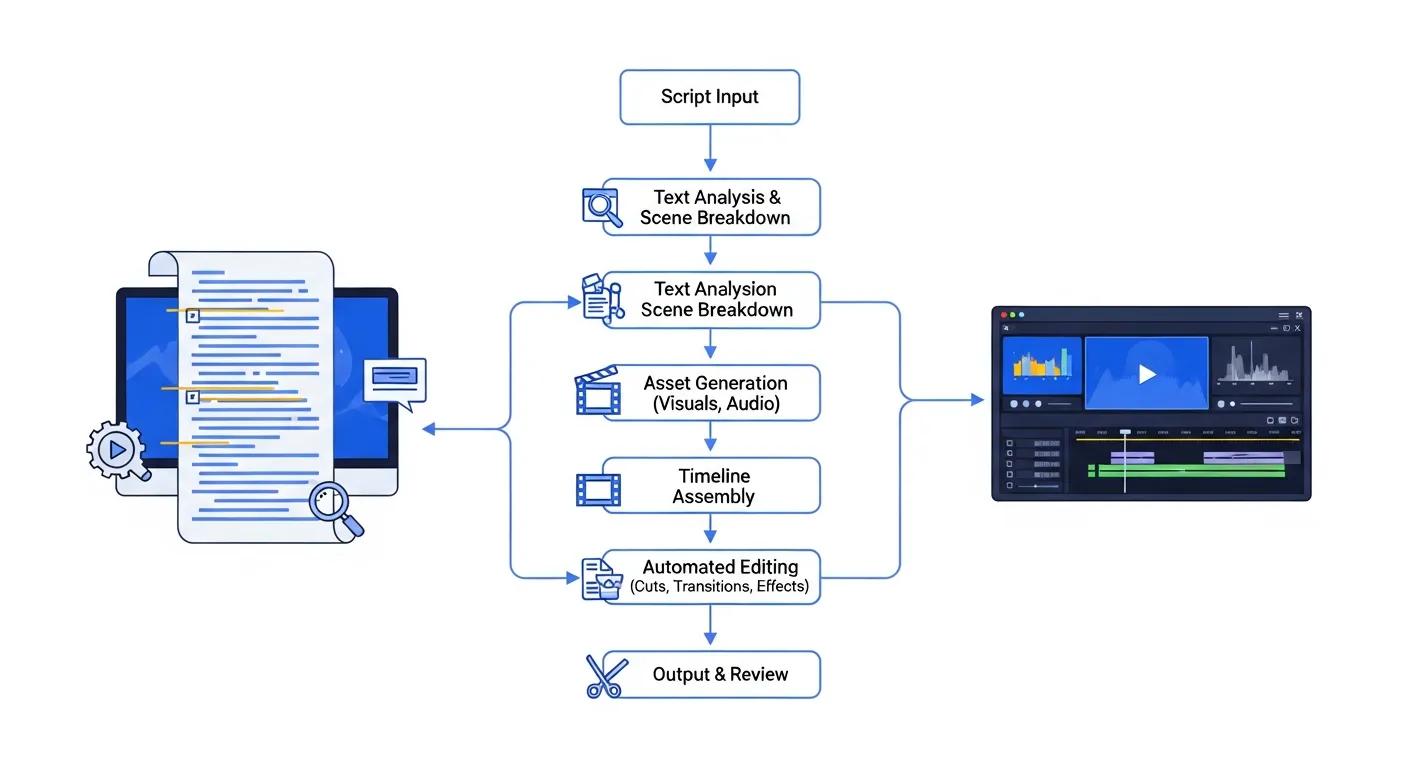
AI chains tasks that were once separate: script parsing, asset selection, scene timing, audio matching, basic color and framing fixes, and assembly. The models interpret inputs and produce coherent sequences with minimal manual tuning.
For example, Synthesia pairs avatar and speech models to turn scripts into finished videos for social and lead‑generation channels, letting creators focus on avatar rather than low‑level edits.
Avatar workflows show how automation cuts production time while keeping consistency.
AI Avatar Video Generation: Automation & Efficiency Gains
Producing high-quality instructional video often hits bottlenecks from manual recording and time‑heavy editing. This paper describes an integrated AI pipeline for avatar video generation that combines facial animation (SadTalker), neural text‑to‑speech (Google Cloud Neural2 TTS with SSML), and optimized processing (FFmpeg). The authors report roughly a 90% drop in production time—from more than 2 hours down to about 15–25 minutes for a 2‑minute video—while preserving roughly 50–60% of visual quality using full‑frame preprocessing to keep backgrounds and context intact. Automated Avatar Video Generation for Scalable Educational Content: Integration of AI-Driven Animation and Natural Voice Synthesis, 2025
What Are the Limitations of Manual Video Editing?
Manual editing delivers depth and polish but is time‑intensive and requires skilled editors. It can create a bottleneck for teams with limited time or budget, and results vary by individual judgment and experience.
These limits drive many teams to adopt AI for repetitive tasks while keeping humans for final creative decisions.
How Do AI Video Editing Tools Improve Efficiency and Scalability?
AI removes repetitive, low‑value steps so teams can produce more videos faster. This gain is especially valuable for marketing, training, and social content where volume and speed matter.
- Time Efficiency Gains: Automating routine edits cuts hours from production and shortens turnaround.
- Cost-Effectiveness: Less manual labor lowers ongoing program budgets.
- Scalability: Automation enables tailored videos at scale across platforms and audiences.
By streamlining workflows, AI frees creators to focus on planning, messaging, and creative direction instead of repetitive technical work.
What Efficiency Gains Do AI Video Generators Offer Compared to Manual Editing?
AI automates assembly, synchronization, and basic polishing so videos that once took hours can be produced in minutes. That reduces per‑video cost and improves consistency across projects.
Faster production increases throughput and removes common review and publishing bottlenecks.
How Do AI Tools Scale Social Media Video Production?
AI repurposes long content into short clips, recommends formats from engagement data, and adapts videos to platform specs automatically. This makes it much faster to publish optimized variations for TikTok, Instagram, LinkedIn, and other channels.
Engagement metrics can feed back to suggest optimal lengths, thumbnails, and crops, turning performance data into operational choices.
What Personalization Features Differentiate AI Video Generators from Traditional Editing?
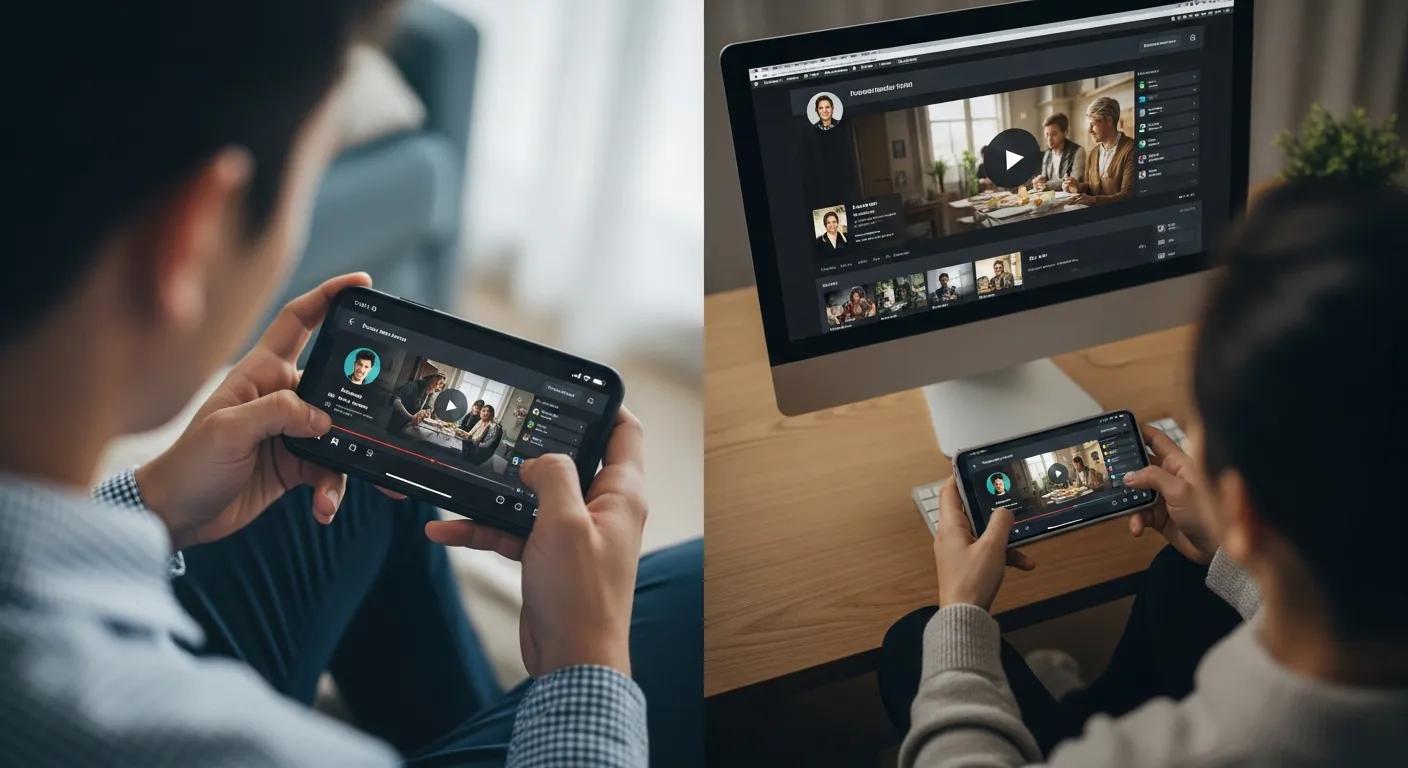
AI makes personalization practical at scale: instead of a single cut, systems can produce many variations targeted by demographics, behavior, or campaign rules.
- Customization Options: Swap language, on‑screen text, offers, or visuals per audience.
- Dynamic Adaptation: Adjust pacing, framing, or calls‑to‑action to improve relevance.
- Audience Targeting: Use engagement signals to generate versions tailored to segments.
Traditional editing can achieve nuanced storytelling but struggles to match AI’s speed and volume for many personalized variants; a hybrid workflow is often optimal.
How Do AI Algorithms Customize Video Content Automatically?
AI analyzes viewer data, past performance, and content structure to select visuals, reorder scenes, and generate voice or text variations, producing versions that better match target audiences without manual re‑edits for each variant.
Synthesia, for example, uses templates, avatar and voice options, and localization features to produce personalized videos that maintain branding while addressing different audiences.
Can Traditional Editing Match AI-Driven Personalization?
Traditional editing can deliver deep storytelling and emotional nuance but cannot match AI for speed or volume when many personalized variants are required. A combined approach—automated generation followed by targeted human refinement—balances scale with craft.
Which AI Video Generators Are Leading the Market Compared to Traditional Editing Software?
Several AI platforms are now common choices for teams that need faster production and personalization, while conventional tools remain the standard for advanced effects and professional finishing.
- Synthesia: Strong in avatar production and multilingual output for consistent videos.
- Pictory: Converts long content to short clips using automated summarization and text‑to‑video features.
- Adobe Premiere Pro: The professional benchmark for detailed editing, effects, and finishing.
These tools represent different priorities: AI platforms for speed and scale, traditional NLEs for depth and control.
What Features Do Synthesia and Pictory Offer?
Synthesia and Pictory each aim to make production faster and more accessible.
| Tool | Key Features | Benefits |
|---|---|---|
| Synthesia | AI avatars; multilingual output; script‑to‑video | Rapid video production; consistent brand delivery across languages |
| Pictory | Automated summarization; text‑to‑video conversion | Easy content repurposing; social media‑ready clips |
These feature sets make it easier to produce repeatable, on‑brand videos without large editing teams.
How Do These AI Tools Compare to Conventional Editors Like Adobe Premiere Pro?
AI platforms prioritize simplicity and templates for non‑specialists; NLEs offer deep professional tools for fine control and advanced effects. Choose based on whether you need speed and scale or precision and polish.
Frequently Asked Questions
What types of projects are best suited for AI video generators?
Fast, repeatable formats benefit most: social clips, marketing campaigns, training modules, and localized variations where volume and personalization matter.
How do AI video generators handle audio and voiceovers?
Most use advanced text‑to‑speech for natural voiceovers and can lip‑sync avatars. Human voiceovers can still be layered for final polish.
Are there any specific industries that benefit more from AI video editing?
Education, marketing, and e‑commerce gain big advantages: scale, personalization, and faster product or lesson production are common wins.
What are the privacy concerns associated with AI video generators?
Privacy centers on data collection and consent. Teams should be transparent about data use and obtain permissions for likenesses and voice synthesis.
Can AI video generators replace human editors entirely?
No. AI handles scale and routine tasks, but human editors provide creative judgment, nuance, and storytelling craft. A hybrid model usually performs best.
What skills are needed to effectively use AI video editing tools?
Good story sense—structure, pacing, and audience awareness—plus familiarity with the chosen platform are most valuable; deep technical skills are often less critical.
Conclusion
AI video generators offer faster production, lower recurring costs, and practical personalization at scale. Traditional editing remains essential for craft and final polish, so combining AI speed with human refinement is a pragmatic approach to producing effective video more efficiently.