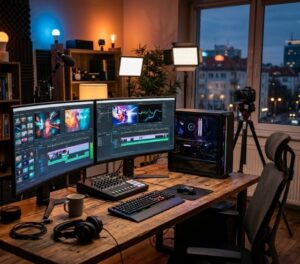






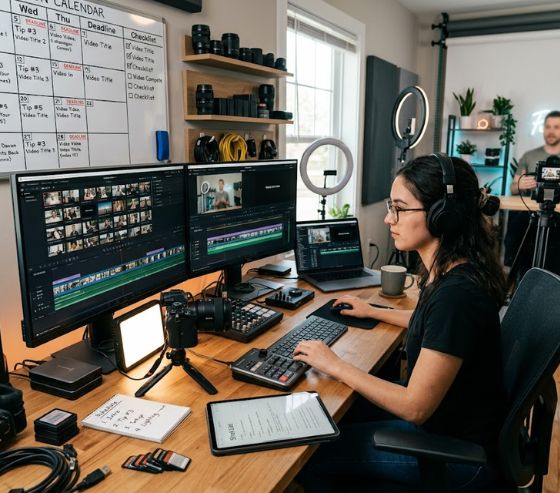
A batch production workflow allows content creators, business owners, and marketing teams to produce 30 high-quality videos in a single day by grouping similar creative tasks into dedicated time blocks. By separating ideation, scripting, filming, and editing into isolated phases, you eliminate daily setup overhead and mental fatigue. This systematic approach transforms an overwhelming daily chore into a predictable, repeatable process that yields an entire month of social media content in eight to ten focused hours.
Consistently posting short-form video on platforms like TikTok, Instagram Reels, and YouTube Shorts is one of the most effective ways to build an online audience. However, attempting to brainstorm, set up equipment, record, edit, and publish a video every single day quickly leads to burnout. Context switching destroys productivity, as moving between creative planning, technical camera operation, and precise editing requires vastly different mental skill sets.
By shifting from a linear, piece-by-piece model to an industrial batch system, you multiply your overall output while dramatically reducing production costs. Whether you are a solo creator operating on a tight schedule or a growing marketing agency scaling client assets, mastering high-volume creation is essential for long-term growth.
Why Daily Video Creation Fails (And Why Batching Works)
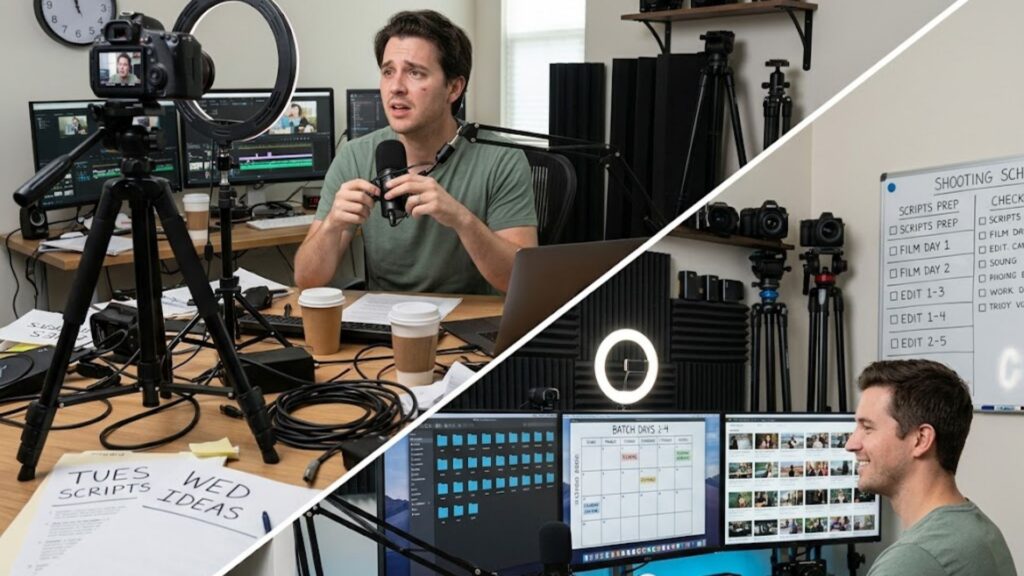
Daily video creation forces you to pay a high energy cost every single day. Setting up lighting, adjusting microphone levels, positioning your camera, and finding the right creative mindset takes 20 to 30 minutes before you even hit the record button. When you repeat this ritual 30 times a month, you waste up to 15 hours solely on equipment configuration and mental preparation.
In contrast, a structured bulk video creation workflow amortizes those fixed setup costs across your entire monthly output. You adjust your lights once, check your audio levels once, and stay in front of the camera until every script is recorded. This continuity allows you to enter a creative flow state where each consecutive video performance feels more natural and authoritative than the last.
Furthermore, batching removes decision fatigue from your daily schedule. When your content calendar is populated weeks in advance, you never have to ask yourself what you should post today. You free up mental bandwidth to focus on core business operations, audience engagement, and long-term strategy.
| Metric / Aspect | Linear Production (1 Video / Day) | Batch Production (30 Videos / Day) |
| Total Setup Time | 15 to 20 Hours per month | 30 to 45 Minutes total |
| Average Time per Video | 60 to 90 Minutes | 15 to 20 Minutes |
| Mental Energy & Friction | High (Daily context switching) | Low (Single focused session) |
| Output Consistency | Irregular (Prone to burnout) | Highly Predictable (30-day bank) |
| Editing & Post-Production | Disjointed and repetitive | Streamlined via templates & AI |
Designing a Scalable Batch Production Workflow for Modern Content Creators
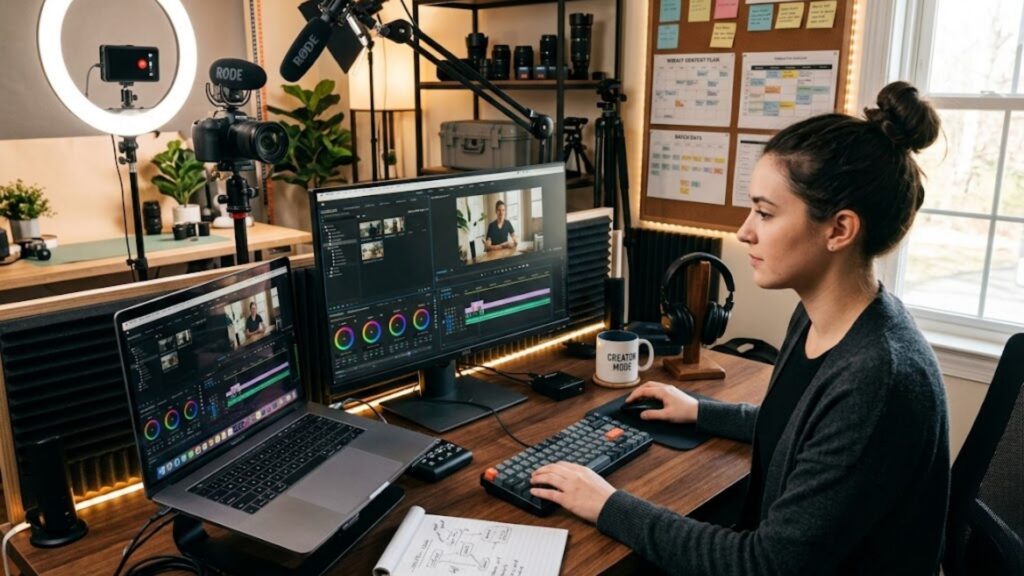
Adopting a standardized batch production workflow eliminates the friction associated with daily video creation and establishes a clear path to high-volume output. To successfully record 30 videos in a single day, your actual production session must be backed by thorough pre-production and a refined asset library.
A successful batch session relies on treating content creation like an assembly line. Every stage of production feeds directly into the next, ensuring no time is lost asking questions about script direction or graphic styles during shooting hours.
Phase 1: Topic Discovery and Rapid Script Generation
The foundation of any high-speed production day is having 30 fully prepared scripts before you touch a camera. Trying to write scripts on the day of filming creates a major bottleneck that slows down your momentum and dilutes your message.
To streamline topic research, group your content into four distinct pillars: educational tutorials, industry commentary, direct answers to customer questions, and product or service highlights. Grouping your ideas into these core categories ensures your content remains diverse yet aligned with your primary business goals.
Using an automated script generator allows creators to draft 30 structured video scripts in under an hour based on real search intent and trending customer questions. This technology provides clear video outlines, hooks, and call-to-actions, ensuring every recording session moves quickly without sacrificing narrative quality.
1. Researching High-Intent Questions
- Scan search engine suggestions and online community forums for recurring customer questions.
- Focus on specific pain points that can be answered in 30 to 60 seconds.
- Organize your selected questions into thematic clusters to maintain visual and verbal consistency.
2. Drafting Structured Hooks and Outlines
- Write three distinct hook options for every script to test different audience triggers.
- Keep core explanations concise, delivering maximum value in as few words as possible.
- Standardize your closing call-to-action so viewers know exactly where to go next.
Phase 2: Setting Up the Production Line for Filming
Executing a 30-video recording day requires an organized environment where physical movement and technical adjustments are kept to an absolute minimum. Prior to your shooting day, verify that your camera equipment, lighting rigs, wireless microphones, and teleprompter apps are tested and fully charged.
To maintain viewer interest across a large volume of content, subtle visual variations can be introduced without breaking your flow. Changing your jacket, switching your background lighting color, or adjusting your seating position every five videos provides visual diversity while keeping you in the same recording station.
Building a flexible content batching system for creators allows service providers and business owners to produce consistent video content without sacrificing client deliverables. Businesses operating across diverse sectors can easily implement tailored video marketing solutions across various industries to reach specific audience demographics without increasing weekly workload.
Batch Recording Best Practices
- Use a Teleprompter: Load all 30 finalized scripts into a teleprompter application to eliminate memorization delays and repeated takes.
- Batch Similar Styles: Record all direct-to-camera educational videos first, followed by product demos or voiceover overlays.
- Record Multiple Takes of Hooks: If a opening line feels flat, re-record the first five seconds immediately while the lighting and audio are identical.
- Take Scheduled Breaks: Pause for ten minutes every hour to drink water, reset your voice, and review your upcoming script batch.
Phase 3: Leveraging Automation and AI for Scalable Video Editing
Editing 30 individual videos using traditional frame-by-frame software can take days if handled manually. To complete post-production in a fraction of the time, modern creators rely on automated processing tools, predefined visual templates, and cloud rendering engines.
Platforms such as Syllaby AI allow you to build an automated content production line that generates engaging visuals, realistic voiceovers, and dynamic dynamic captions without requiring complex camera setups or manual video timelines.
For creators who prefer not to appear on camera, a faceless video automation pipeline provides an exceptionally fast way to produce high volumes of informative content. By combining automated voiceover generation with relevant stock media and background graphics, you can turn text outlines into finished videos in minutes.
Integrating a specialized faceless video creation feature into your workflow helps maintain a steady stream of educational shorts while saving dozens of recording hours each month. This strategy works particularly well for topical news updates, listicles, and technical tutorials.
Furthermore, creators can transform existing podcasts, voice notes, and audio interviews into polished video assets by applying advanced audio-to-video AI technology to automatically combine sound files with dynamic wave captions and visual backgrounds.
Phase 4: Post-Production, Formatting, and Multi-Platform Publishing
Once your primary video clips are edited, they must be formatted for maximum reach across short-form platforms. Vertical formats with a 9:16 aspect ratio are standard for mobile viewers on TikTok, Instagram Reels, and YouTube Shorts.
Batch editing software allows you to apply platform-appropriate captions, sound enhancement, and branding overlays across all 30 files simultaneously. This ensures your visual branding remains uniform across every social channel you manage.
To streamline distribution, technical teams and agencies can utilize developer API integration options to feed finished video files directly into custom publishing dashboards and client portals. Automated scheduling ensures your batch-produced videos are published at optimal engagement times throughout the month.
Key Steps for Distribution Prep
- Export all rendered files with clear, descriptive file names corresponding to your content calendar.
- Generate platform-specific titles, descriptions, and hashtags for each piece of content.
- Upload finished assets to a scheduling platform to ensure continuous, hands-free posting.
Best Practices for Quality Control in Bulk Content Creation
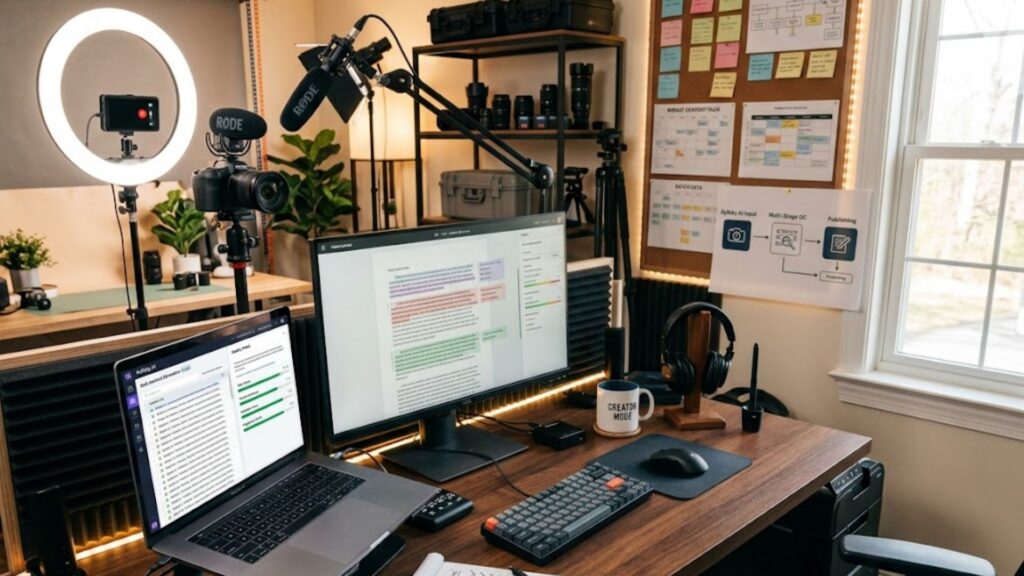
High-volume production should never come at the expense of content quality or brand trust. When producing content in large batches, maintaining strict quality control measures guarantees that every piece of video reflects your professional standards.
Establish a simple checklist to review each video before it enters your publishing queue. Verify that audio levels are balanced, captions are free of typographical errors, and branding elements are clearly visible.
For growing businesses and agencies evaluating tools to streamline high-volume video workflows, reviewing flexible subscription plans helps identify software options that match your team size and operational budget. Syllaby AI offers scalable toolsets designed to support both individual creators and high-output marketing teams.
By leveraging Syllaby AI alongside structured templates, creators ensure every video meets high visual and narrative standards while maintaining a rapid production schedule.
Frequently Asked Questions
How long does it take to complete a 30-video batch production day?
A well-prepared batch production session typically takes between six and eight hours. This includes roughly one to two hours of setup and environment checks, three to four hours of filming or automated generation, and two hours of final rendering, review, and scheduling.
What basic equipment is needed for video batching?
At minimum, you need a high-resolution smartphone camera or digital camera, a stable tripod, a soft directional light, and a wireless clip-on microphone. Software tools like teleprompter apps and automated caption generators further accelerate the process.
Can small businesses use batch video production effectively?
Yes, batch production is particularly valuable for small businesses with limited marketing bandwidth. By dedicating one day per month to video creation, business owners maintain a strong social media presence without disrupting daily operations.
Is faceless video creation effective for high-volume batching?
Faceless video creation is highly effective for high-volume content strategies. It eliminates the need for camera setups, hair and makeup preparation, and multiple camera takes, allowing creators to produce educational and promotional content much faster.
How do you maintain high energy levels when recording 30 videos back-to-back?
To stay energized throughout a filming day, record your videos in blocks of six to eight scripts. Take brief rest breaks between blocks, stay hydrated, and adjust your posture or clothing slightly to keep your physical presentation fresh.
Conclusion
Implementing a structured batch production workflow is the ultimate way to stay consistent on social media without burning out. By systematically grouping research, filming, editing, and distribution into focused operational phases, you transform video creation into an efficient engine for audience growth.
With the right tools and automated systems, producing 30 engaging, authoritative short-form videos in a single day is well within reach for any creator or business. Explore the Syllaby AI platform today to discover how automated scripting, voice generation, and avatar technology can elevate your content pipeline. If you have questions about setting up a custom workflow for your team, feel free to reach out to our support team to get started.