






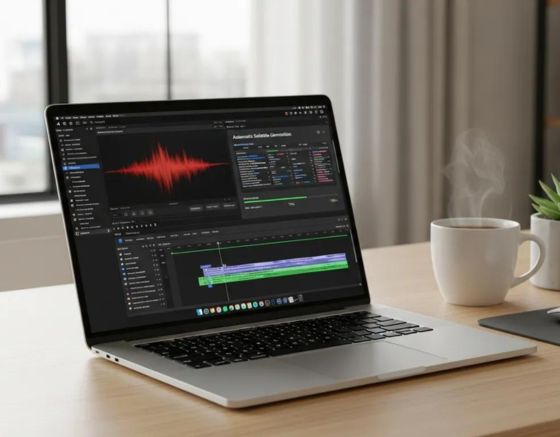
Video is central to communication, marketing, and education, yet producing engaging videos often requires substantial time—particularly for subtitles and captions. AI video editors automate subtitle generation and improve accessibility. This article explains how automatic subtitle generators work, the benefits for creators, and their effects on audience engagement. It reviews the underlying technology, social media integration, caption accuracy, and considerations for selecting suitable software.
Key Takeaways
- AI-powered automatic subtitle generators transcribe spoken dialogue into text using advanced speech recognition algorithms.
- These tools significantly reduce time and effort required for creating accessible video content with accurate captions.
- Popular transcription tools like Rev, Otter.ai, and Descript support automatic captioning with unique features.
- AI video captioning enhances social media engagement by making videos accessible to sound-off viewers on platforms like Instagram.
- Customization options for captions include font style, size, color, and positioning to improve readability and branding.
- Captioned videos increase viewer retention and sharing, boosting audience engagement and lead generation.
- Advancements in deep learning improve AI transcription accuracy, especially in noisy environments and with multiple speakers.
- Users can edit auto-generated captions to ensure precision and maintain content quality and style.
- AI captioning platforms offer common output formats like SRT and VTT and integrate with social media and marketing tools.
What Is an AI-Powered Automatic Subtitle Generator?
An AI-powered automatic subtitle generator is software that uses artificial intelligence to transcribe spoken dialogue into text and produce subtitles or captions for videos. These tools apply speech recognition and natural language processing to convert audio to written form. The main advantage is a large reduction in the time and effort required to create accessible video content, allowing creators to focus on production and distribution while reaching a wider audience.
Research continues to advance AI systems that improve video accessibility by automating subtitle generation across multiple languages.
AI-Powered Automated Subtitle Generation for Video Accessibility
This project aims to develop an AI-supported automated subtitle generation system that makes Kannada, Hindi, and English videos more accessible by producing accurate, synchronized subtitles. Intelligent Audio-to-Text Framework: Natural Language Processing Based AI-Powered Transcription and Subtitle Creation System, 2025
How Does AI Speech Recognition Enable Subtitle Automation?
AI speech recognition enables subtitle automation by analysing audio and converting it to text through layered algorithms. Services such as Google Cloud Speech-to-Text and IBM Watson Speech to Text use machine-learning models trained on large datasets to improve accuracy. This approach accelerates transcription and helps produce contextually relevant, grammatically appropriate subtitles for viewers.
Which Video Transcription Tools Support Automatic Captioning?

Several transcription tools provide automatic captioning with features tailored to different workflows. Popular options include:
- Rev: Known for its high accuracy and quick turnaround, Rev provides both automated and human transcription services.
- Otter.ai: This tool excels in real-time transcription and collaboration, making it ideal for meetings and lectures.
- Descript: A versatile tool that combines video editing with transcription, allowing users to edit audio and video by editing text.
These platforms streamline captioning and improve the overall video-editing workflow.
How Do AI Video Captioning Software Enhance Social Media Video Editing?
AI captioning automates subtitle creation, a critical feature for social media where many users view videos without sound. Integrating AI-driven caption tools ensures videos are accessible to a broader audience, including viewers with hearing impairments, and supports clearer messaging in short-form formats.
What Personalization Features Allow Custom Caption Styling?
Many captioning tools include personalization features for caption appearance: font style, size, color, and on-screen position. These options support branding and improve readability. For example, selecting contrasting colors enhances visibility across varying backgrounds and helps increase engagement and retention.
Subtitle customization is a key area of innovation, with new tools giving creators greater control over presentation and accessibility.
Customizable AI Subtitling Tools for Enhanced Video Creation
Conventional subtitling methods struggle to meet diverse audience needs. This paper introduces TransVisio, an AI-powered tool that customizes subtitles to improve subtitle creation. Introducing Transvisio: A customizable AI-powered subtitling tool, H Abu-Rayyash, 2024
How Does Captioning Automation Improve Video Engagement on Platforms Like Instagram and TikTok?

Captioning automation improves engagement on platforms such as Instagram and TikTok. Studies indicate captioned videos can raise viewer retention by up to 80% because they accommodate sound-off viewing. Captioned content is also more likely to be shared, extending reach. Using AI video editors, creators can deliver high-quality videos with captions that better connect with their audience.
What Are the Benefits of Using AI Subtitle Generators for Content Creators and Marketers?
AI subtitle generators deliver clear benefits for creators and marketers, including:
- Efficiency in Content Creation: Automating captions saves time, enabling focus on content quality and strategy.
- Accessibility for Diverse Audiences: Subtitles make videos usable by non-native speakers and people with hearing impairments, expanding reach.
- Increased Audience Engagement: Captions support higher retention and interaction on social platforms.
Leveraging these advantages helps creators maximise the impact and distribution of video content.
How Does Automation Save Time and Increase Scalability?
Automation reduces the time required for captioning. Where manual methods can take hours, AI can produce accurate subtitles in a fraction of that time. This efficiency enables scalable production, allowing creators to publish more content without compromising quality and to reallocate time toward ideation or polishing production.
What Impact Do Captioned Videos Have on Lead Generation and Audience Retention?
Captioned videos support lead generation and audience retention by making content more accessible and engaging. Research shows captioned videos can improve retention rates by up to 60%, as viewers are likelier to watch through when they can read along. Higher engagement increases brand visibility and strengthens audience relationships, which can contribute to conversions.
How Accurate Are AI Video Editors in Generating Subtitles and Captions?
Accuracy of AI-generated captions has improved with technological advances. Modern algorithms can recognise a range of accents and dialects, producing more precise transcriptions. Accuracy still depends on audio quality and background noise, so users should review and edit captions to ensure final precision.
What Advances in AI Transcription Technology Improve Accuracy?
Recent advances such as deep learning and neural networks have improved transcription accuracy by enabling systems to better interpret context and speech nuances. These approaches help distinguish similar-sounding words and reduce errors. Continued development is expected to further raise the reliability of AI-generated captions.
Deep learning techniques are proving effective at addressing challenges like noisy environments and multiple speakers, improving transcription accuracy.
Deep Learning for Accurate Voice-to-Text Transcription in Noisy Environments
This quantitative, cross-sectional, case-based study examined why cloud and enterprise voice-to-text deployments still produce variable transcription accuracy in noisy, multi-speaker settings and whether Deep Learning ASR Capability (DL) and Speaker Diarization Quality (SD) act as complementary drivers of perceived Transcription Accuracy in Noise (TA). The Impact of Deep Learning and Speaker Diarization On Accuracy of Data-Driven Voice-To-Text Transcription in Noisy Environments, A Mamun, 2023
Can Users Edit Auto-Generated Captions for Better Precision?
Yes. Many AI video editing platforms permit users to edit auto-generated captions to correct inaccuracies and refine flow. This capability is essential for meeting quality standards and preserving a creator’s voice and style.
Which Output Formats and Integration Options Do AI Captioning Platforms Offer?
AI captioning platforms provide multiple output formats and integration options. Standard subtitle formats include SRT and VTT, both widely supported by video platforms. Many editors also integrate with social media and marketing tools to streamline workflows and content distribution.
What Are Common Subtitle Formats Like SRT and VTT?
SRT (SubRip Subtitle) and VTT (Web Video Text Tracks) are common subtitle formats. SRT files are simple text files with timed subtitle entries, making them easy to create and edit. VTT files support additional styling and metadata. Both formats are compatible with major platforms to ensure proper caption display.
How Do AI Video Editors Integrate with Social Media and Marketing Tools?
AI video editors typically offer integrations with social media and marketing platforms to simplify publishing. For example, platforms like Syllaby let users export videos directly to social channels with captions included. These integrations save time and help optimise content for each platform.
How Can Users Choose the Best AI Video Captioning Software for Their Needs?
Selecting the right captioning software requires evaluating features, pricing, and user feedback. Assess project requirements and choose a tool that aligns with your goals. Reviewing case studies and testimonials can provide practical insight into a platform’s effectiveness.
What Pricing Plans and Features Should Be Considered?
Consider pricing plans that match your volume and feature needs. Many vendors use tiered pricing based on processed minutes, advanced customisation, or collaboration features. For example, Syllaby offers plans designed for different user profiles to help creators find an appropriate solution.
How Do Case Studies Demonstrate Effectiveness in Different Industries?
Case studies show how automated captioning is applied across sectors. Educational institutions use captions to improve accessibility for students with hearing impairments. Marketers leverage captioned videos to raise engagement and conversions. These examples demonstrate the practical value of AI-powered captioning in varied contexts.
For further inquiries or personalized assistance, users can visit the contact page to connect with support and sales teams.
Frequently Asked Questions
What are the limitations of AI-generated subtitles?
AI-generated subtitles still face limits. Poor audio quality, strong accents, and background noise can reduce accuracy. AI can also misinterpret context, leading to errors with homophones or idiomatic expressions. Review and edit auto-generated captions to ensure they reflect the intended message and meet quality standards.
How can businesses benefit from using AI subtitle generators?
Businesses can use AI subtitle generators to strengthen marketing and customer engagement. Captions make video content accessible to wider audiences, including non-native speakers and people with hearing impairments, which can increase reach. Captioned videos also support higher retention, improving engagement and potential conversions, and contributing to stronger brand recognition.
Are there specific industries that benefit more from AI captioning tools?
Yes. Education benefits from automated captions that support learners with hearing impairments or language barriers. Marketing and advertising gain higher engagement and conversion potential. The entertainment industry uses captioning to ensure accessibility and reach wider audiences.
What role does user feedback play in improving AI captioning software?
User feedback is essential for improving captioning software. Developers rely on user insights to identify accuracy issues, usability gaps, and feature requests. Analysing feedback helps refine algorithms and interfaces so the software better serves creators and marketers.
How do AI video editors handle multiple languages in subtitles?
AI editors with multilingual capabilities can generate subtitles in various languages. They use natural language processing to transcribe and translate spoken dialogue. Users select the desired output language, and the software adapts captions accordingly, which supports global distribution and accessibility.
What are the best practices for editing auto-generated captions?
Best practices include listening to the audio while reviewing captions to identify discrepancies, maintaining consistent formatting for readability, ensuring captions are synchronised with audio, and using clear, concise language to aid understanding for non-native speakers.
Can AI subtitle generators be used for live events?
Yes. Many generators support live events through real-time transcription. They can produce on-the-fly captions for webinars, conferences, and broadcasts. Accuracy may vary with audio quality and speaker clarity, so it is advisable to have a backup plan, such as a human editor, for important live presentations.
Conclusion
AI video editors transform subtitle and caption workflows, improving accessibility and viewer engagement. By automating captioning, these tools save time and let creators concentrate on content quality while scaling production. With customization and integration options, users can tailor videos to diverse audiences and distribution channels. Evaluate AI-powered captioning tools to enhance your video content and reach.