






Most creators pick a voice the same way they pick a phone case, by listening to three samples and going with whichever one sounds least annoying. That is why so many faceless channels sound interchangeable. Choosing AI voices is actually a casting decision, and the rule is simple: use text to speech when you need a professional narrator fast, and use voice cloning when the voice itself is part of your brand. Everything else is detail on top of that one split.
The detail matters, though, because the wrong voice for your niche costs you watch time before your script gets a chance. A calm, measured narrator that builds trust on a finance channel will flatten a horror story. A dramatic, expressive voice that keeps people hooked through a twenty minute mystery will make a software tutorial feel like a movie trailer. Same technology, opposite outcomes.
This guide covers what actually separates the two approaches, which voice profile fits which niche, what makes narration sound human instead of synthetic, and where the disclosure rules land. By the end you should be able to make the call in about five minutes instead of five weeks of second-guessing.
What Separates Voice Cloning From Text to Speech
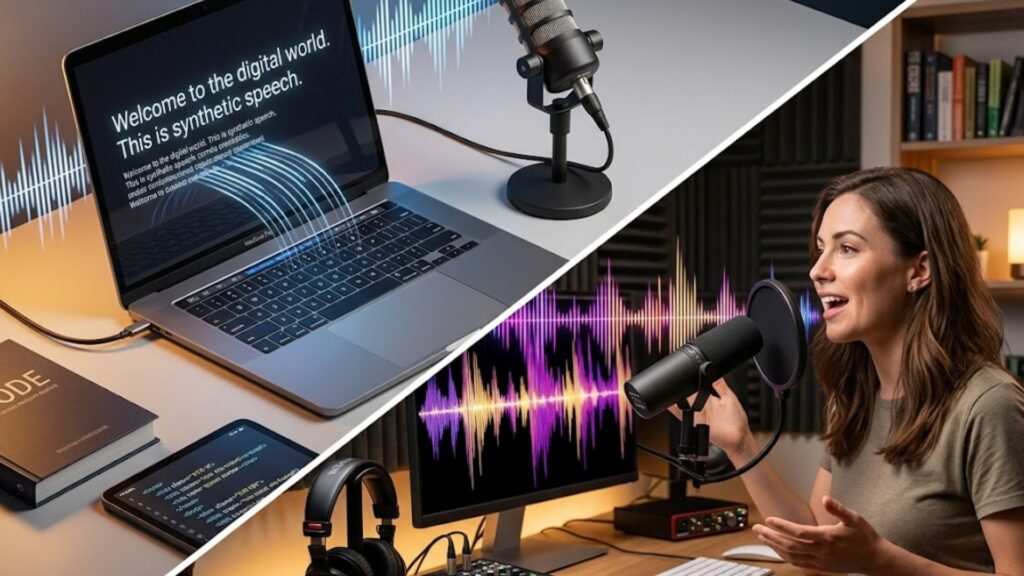
Text to speech and voice cloning solve two different problems. Text to speech gives you a professionally designed voice you did not have to create. Voice cloning gives you a specific person’s voice, reproducible on demand. The output format is identical, but the setup, the cost, and the legal footing are not.
Both sit on decades of speech synthesis work, which is why the quality jumped so sharply in recent years. Early systems like Bell Labs’ Voder were intelligible but robotic. Concatenative synthesis stitched together recorded fragments for better naturalness. The current generation runs on neural models, including architectures like WaveNet and Tacotron, which is what made pitch, cadence, and breathing patterns possible to reproduce.
How Text to Speech Works
You browse a voice library, filter by language, gender, age, and tone, paste your script, and export the audio. No recording, no sample, no waiting. Platforms like ElevenLabs, Murf AI, Play.ht, WellSaid Labs, Azure Neural TTS, and OpenAI’s voice set all operate on this model, with libraries running into hundreds of voices across dozens of languages.
The strength is speed and coverage. Microsoft Edge TTS and Azure Neural TTS between them cover hundreds of language and accent combinations, which matters if you plan to publish the same video in Spanish, Portuguese, Hindi, or Arabic. The tradeoff is that the voice is not yours, and someone else in your niche may be using the same one.
How Voice Cloning Works
Voice cloning trains a custom model on samples of a real voice, then generates new speech in that voice. The model learns pitch, timbre, cadence, accent, and breathing pattern, and applies them to any text you feed it. Once trained, it produces unlimited narration that sounds like the original speaker.
The sample requirements are lower than most people assume. Most platforms build a usable model from 30 seconds to a few minutes of clean audio. Narration Box, for example, accepts samples from 10 seconds up to 300 seconds, and reports that around 180 seconds produces the best results. Rapid cloning systems such as Altered’s advertise usable clones from as little as 4 to 8 seconds, though quality scales with sample length.
Input quality sets the ceiling on output quality. The universal requirements are clean audio with no background music or effects, a single speaker, consistent volume, and a consistent recording environment. A noisy sample produces a noisy clone regardless of how good the platform is.
Choosing AI Voices: Cloned or TTS for Your Channel
Choosing AI voices between cloning and a library comes down to four questions: does the voice need to be a specific person, how fast do you need to launch, how many languages will you publish in, and who holds the rights. Answer those four and the decision usually makes itself.
Here is how the two approaches compare on the factors that actually affect a working channel.
| Factor | Text to Speech Library | Voice Cloning |
| Setup time | Minutes, no sample needed | 10 seconds to 5 minutes of clean audio, plus training |
| Best for | Fast narration, e-learning, ads, explainers, multi-language | Brand voice, personal channels, dubbing a specific speaker |
| Voice uniqueness | Shared, others may use the same voice | Unique to you |
| Language coverage | Very broad, often 40 to 140+ languages | Narrower, depends on the model |
| Consent and rights | Licensed by the platform, check commercial terms | Requires explicit consent, often identity verification |
| YouTube disclosure | Generally not required for standard narration | Not required for your own voice, required for someone else’s |
| Typical use case | You need a good narrator now | The voice is part of the brand |
The practical read is this. If you are launching a new faceless channel this week, start with a library voice, because you can test five niches without recording anything. If you already have an audience that knows your voice, or you are building a business where the narrator is the brand, clone it. Teams handling content across several different verticals often run both, using cloned narration on the flagship channel and library voices on experimental ones. Syllaby AI supports either path, so the choice does not have to be permanent.
Which Voice Fits Which Niche
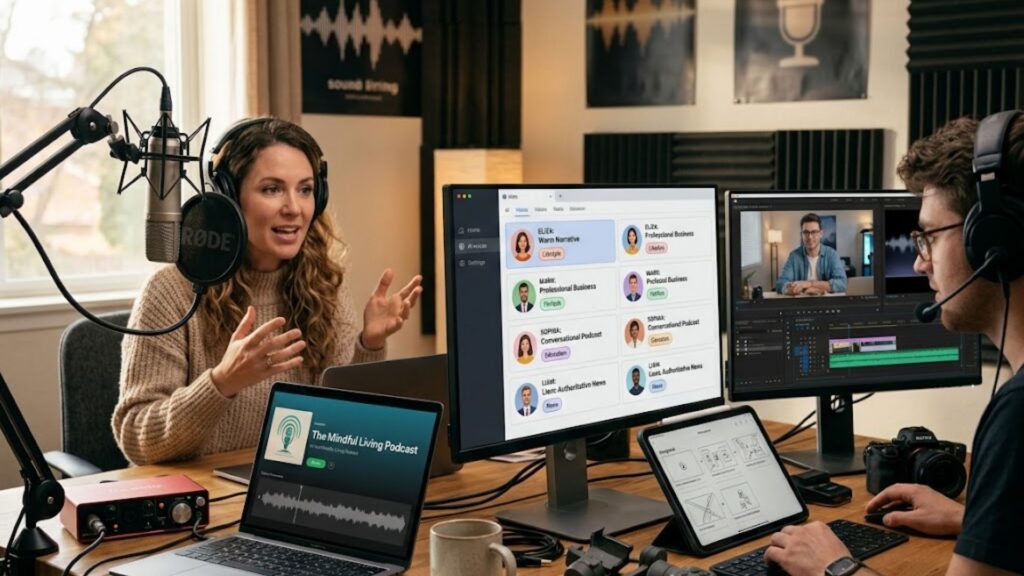
Voice-to-niche matching follows audience expectation, not personal taste. Viewers arrive with an unconscious template for how this kind of content should sound, and matching it removes friction. The niche patterns below are consistent across the highest-performing faceless categories.
Finance, Business, and SaaS
Use an authoritative, measured, mid-to-low register voice with minimal emotional swing. Finance carries the highest CPM on YouTube, and money content lives or dies on perceived credibility. A steady, unhurried narrator reads as competence, while an energetic one reads as a sales pitch.
- Pacing: slightly slower than conversational, around 135 to 145 words per minute
- Register: mid-to-low, clean articulation, minimal vocal fry
- Avoid: rising intonation at sentence ends, which undercuts authority
- Library voices in this lane are common enough that OpenAI’s onyx has become a default for finance and self-improvement channels
True Crime, Horror, and Story Narration
Use a warm, expressive voice with real dynamic range and the ability to slow down for tension. This is the one niche where emotional capability outweighs everything else, because the voice has to sustain suspense across ten to twenty minutes. According to Scenith’s niche breakdown, expressive narrators noticeably outperform neutral ones on retention in story-driven categories.
Channels like Lazy Masquerade proved this format works with no face at all. The narration carries the entire emotional load, which is why a flat delivery kills a good script here faster than in any other niche.
History and Documentary
Use a deep, calm, slightly formal voice, often with a British accent. Documentary audiences have decades of BBC-style conditioning, and accent authenticity does real work for credibility. Vocallab’s testing across automation channels found authoritative British male documentary voices drove the longest watch times in narration-heavy content, which tracks with that expectation.
Tech, Tutorials, and Explainers
Use an energetic, conversational, friendly voice at a slightly faster clip. Tutorial viewers are task-focused and often watching at 1.25x or 1.5x speed, so clarity under acceleration matters more than warmth. Test any candidate voice at 1.5x before committing, because some voices degrade badly when sped up.
This is also the niche where library voices are entirely sufficient, since nobody watching a “how to fix this error” video cares whose voice is explaining it. Creators building this kind of library at volume through an automated faceless video workflow usually settle on one clear explainer voice and reuse it across every upload for consistency.
Self-Improvement and Motivation
Use a warm voice with moderate authority and deliberate pauses. Motivation content depends on the pause more than the words. A voice that can hold a beat after a key line lands harder than one that plows through the script.
Kids, Health, and Education
Use a gentle, clearly articulated voice with generous spacing between ideas. Comprehension beats personality here. For health content specifically, avoid overly dramatic delivery, since it reads as untrustworthy on medical topics.
What Makes a Realistic AI Narrator Voice
A realistic AI narrator voice is defined by pacing and breath, not by raw model quality. Listeners forgive an imperfect timbre and immediately reject unnatural rhythm. The current best models are close enough on timbre that delivery is now the main differentiator. In blind listening comparisons reported by AiTwo, top-tier voices were correctly identified as AI only around 6 percent of the time.
The controllable variables are these:
- Natural pauses. Insert breaks at commas and paragraph breaks. Narration with no breathing room sounds rushed even at a normal word rate.
- Chunked generation. Generate in paragraph-sized segments rather than one long block. Long single passes drift in tone and energy.
- Pronunciation overrides. Fix names, acronyms, and technical terms manually. One mangled word breaks the illusion for the whole video.
- Loudness normalization. YouTube normalizes playback to roughly -14 LUFS. Master to that target so your audio does not get pushed down and sound thin next to competitors.
- Consistent voice across uploads. Switching narrators between videos costs you recognition. Pick one and keep it.
Writing style also affects perceived realism. Sentences under 20 words, contractions, and direct address all make synthesized speech sound more human, while long subordinate clauses expose it immediately. Platforms such as Syllaby AI generate the script and the narration in the same pass, which helps here because the script is written for the voice rather than adapted to it afterward.
Disclosure, Consent, and Commercial Rights
YouTube’s guidance on altered or synthetic content draws a clear line. Cloning your own voice to create voiceovers or dubs is listed as an example that does not require disclosure. Cloning someone else’s voice to create voiceovers or dubs is listed as something that does require disclosure. That single distinction covers most creator scenarios.
Standard narration using a licensed library voice for tutorials, explainers, documentaries, and faceless channels generally does not require disclosure either. Monetization eligibility depends on originality and effort, not on whether a human or a model read the script. Low-effort, mass-produced content gets flagged for being low-effort, and AI narration neither causes nor cures that.
Three rules keep you safe regardless of platform policy changes:
- Clone only your own voice, or a voice where you hold written, informed consent
- Never clone a celebrity, public figure, or any recognizable person without permission
- Verify commercial usage rights on any library voice before monetizing, since terms vary by platform and by plan tier
Regulatory direction is toward more disclosure, not less, with frameworks in the EU moving that way. Building the habit now costs nothing and protects you later.
The Cost Math
The cost gap is the reason this technology took over faceless publishing. A freelance ten minute voiceover runs roughly $100 to $400 at typical marketplace rates. AI narration for the same length costs cents. Narration Box, as one reference point, prices around $0.06 per 1,000 characters, which covers roughly 8 to 10 minutes of audio.
Time is the larger saving. Most YouTubers spend 30 to 50 percent of total production time on voiceover work: scripting for delivery, recording, cleaning noise, and re-recording flubbed lines. Removing that step turns a four to five hour narration cycle into something closer to 15 minutes.
Pricing models differ in ways that matter at volume, since some platforms charge by character and others by rendered video minute. Comparing plan structures against your actual publishing cadence before committing avoids the common trap of buying for the volume you hope to hit rather than the volume you currently produce.
Agencies and multi-channel operators often bypass the interface entirely, wiring narration and rendering into their own systems through a programmatic video endpoint so one script can produce dozens of language and voice variants without manual work. The voice decision stays the same, only the delivery scales.
How to Test a Voice Before You Commit
Run every candidate voice through the same short audition before you build a channel around it. This takes twenty minutes and saves months.
- Generate your actual hook, not a vendor demo script. Demos are chosen to flatter the voice.
- Play it at 1x, 1.25x, and 1.5x. Many voices fall apart above 1.25x.
- Include your hardest words: brand names, numbers, acronyms, foreign terms.
- Listen on phone speakers, not headphones. That is how most of your audience will hear it.
- Generate a two minute passage, not ten seconds, to check for tonal drift.
- Compare against your current voiceover directly if you already have one.
If retention is already flat and a new voice does not move it, the bottleneck is the script rather than the narration, and it is worth reviewing the full production workflow with a specialist before churning through more voice options. Syllaby AI users tend to lock a voice early and spend their testing budget on hooks instead, which is usually where the actual gains sit.
Frequently Asked Questions
What is the difference between AI voice cloning and text to speech?
Text to speech uses a pre-built synthetic voice from a library that anyone on the platform can use. Voice cloning trains a custom model on samples of a specific real person’s voice, then generates new speech in that voice. Text to speech needs no sample and works instantly. Cloning needs clean audio and, when the voice is not yours, documented consent.
How much audio do I need to clone my voice?
Most platforms build an accurate model from 30 seconds to a few minutes of clean, single-speaker audio. Some accept as little as 10 seconds, with roughly three minutes producing the best results. Rapid cloning systems advertise usable output from 4 to 8 seconds, but quality improves with longer samples.
What is the best AI voice for a faceless YouTube channel?
It depends on the niche. Finance and documentary channels perform best with authoritative, measured voices. Tech and tutorial channels need energetic, conversational delivery. True crime and story narration benefit from dramatic, expressive voices with wide dynamic range. There is no single best voice, only a best match for audience expectation.
Does YouTube penalize videos with AI narration?
No. YouTube’s monetization decisions rest on originality and effort, not on whether narration is human or synthetic. Disclosure is required when synthetic audio makes it appear that a real, identifiable person said something they did not. Cloning your own voice for your own script does not require a label.
Can I use a cloned voice for monetized content?
Yes, provided you own the voice or hold written consent from the person who does, and the platform’s terms permit commercial use. Cloning your own voice for a monetized channel is standard practice. Cloning a recognizable public figure is not permitted on any reputable platform and creates both policy and legal exposure.
Final Thoughts
Choosing AI voices well is less about finding the most impressive sample and more about matching three things: the technology to your brand needs, the voice profile to your niche’s expectations, and the delivery settings to how your audience actually listens. Start with a library voice if you are testing, clone if the voice is the brand, and match the register to the category rather than to your own preference.
Then stop optimizing it. Pick the voice, lock it in, and put your remaining energy into scripts and hooks. A good voice reading a weak script still loses. A decent voice reading a sharp one wins consistently, and that is where the leverage has always been.