






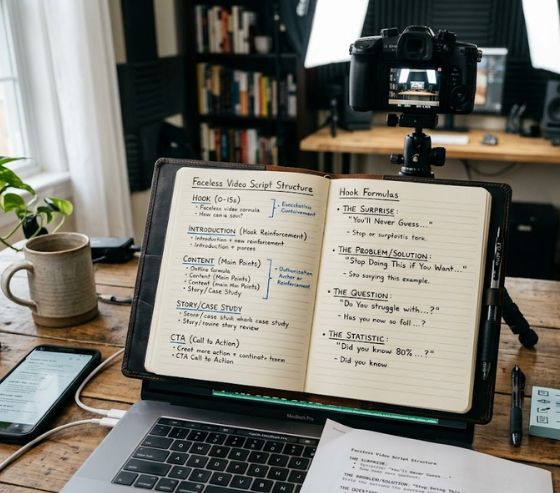
Your faceless videos are probably not failing because of the footage. They are failing in the first three seconds, before the voiceover even reaches the point. A working faceless video script structure follows five blocks in a fixed order: hook, promise, context, payoff, and close. Each block has a job, a time budget, and a word count, and when one of them is missing or bloated, retention collapses in a way that better stock footage cannot rescue.
This matters more for faceless content than for anything else you publish. When there is no host on screen, there is no face to borrow trust from, no eye contact, no personality carrying the dull parts. The words and the order of the words do all of the work. That is why two channels can use the same visuals, the same AI voice, and the same niche, and one gets 200 views while the other gets 200,000.
The good news is that this is a solvable, repeatable problem. Attention follows patterns, and those patterns have been documented well enough that you can build them into a template and reuse it forever. Below is the full breakdown: the structure, the hook formulas that stop the scroll, the word budgets, and the mistakes that quietly kill your watch time.
Why the Script Carries a Faceless Video

The script is the only attention mechanism you fully control in a faceless video. Thumbnails and titles win the click. The script wins the next thirty seconds, and the next thirty after that. YouTube even exposes this as a metric for Shorts called “Viewed vs. Swiped Away,” which tells you exactly how many people bailed before your content started.
The decision window is brutally short. Viewers on TikTok, Instagram Reels, and YouTube Shorts decide in roughly two to three seconds whether to keep watching. According to Zebracat’s 2025 YouTube Shorts data, Shorts that deliver a hook inside the first two seconds retain about 19 percent more viewers than those that ease in with setup.
None of this requires showing your face. YouTube’s Partner Program threshold is 1,000 subscribers plus either 4,000 public watch hours or 10 million valid public Shorts views in 90 days, and no part of that requires being on camera. The script is what gets you there.
Platforms are also reading the drop-off as a quality signal, not just a stat for your dashboard. If a large share of viewers leave in the first second, distribution shrinks. If they stay, the video gets pushed further. Your opening line is effectively a distribution decision.
The Faceless Video Script Structure That Holds Attention
The faceless video script structure that consistently works has five blocks, in this order: hook, promise, context, payoff, and close. The hook stops the scroll. The promise tells viewers what they are getting. The context makes the payoff make sense. The payoff delivers what you promised. The close gives an emotional or practical landing so viewers finish instead of drifting off.
The most common failure is treating these as suggestions rather than a sequence. Creators write the context first because it feels logical, then wonder why nobody reaches the payoff. Start with the hook, then work backward. If you know the promise you are making in second four, every later line has a filter: does this serve the promise, or is it filler?
Here is how the blocks map to timing and word count for both formats. Spoken narration runs roughly 140 to 150 words per minute, which is where these numbers come from.
| Script Block | Shorts (30 to 60 sec) | Long-Form (5 to 10 min) | Job of This Block |
| Hook | 0 to 3 sec, 8 to 15 words | 0 to 10 sec, 20 to 25 words | Stop the scroll, open a loop |
| Promise | 3 to 5 sec, 8 to 12 words | 10 to 25 sec, 30 to 60 words | State what the viewer gets |
| Context | 5 to 12 sec, 15 to 25 words | 25 to 90 sec, 60 to 200 words | Make the payoff land |
| Payoff | 12 to 50 sec, 90 to 120 words | 90 sec to 8 min, 500 to 1,100 words | Deliver the promise |
| Close | Final 3 to 5 sec, 10 to 20 words | Final 20 to 40 sec, 50 to 90 words | Resolution plus one clear action |
Those word counts are the part most guides skip, and they are the part that fixes pacing. A five to ten minute faceless video needs roughly 700 to 1,500 words of narration total. If your draft is 2,400 words, you are not writing a ten minute video, you are writing a seventeen minute one, and the pacing will feel like it.
The Payoff Needs Internal Structure Too
Long payoff sections need re-engagement points or viewers drift, even when the information is good. Place a pattern interrupt every 60 to 90 seconds in the payoff block: a question, a surprising number, a change of tone, or a reframe of what came before. These are cheap to write and they show up clearly on your retention graph as small bumps instead of a steady slide.
Faceless creators who publish across multiple verticals often keep one payoff skeleton per format and swap the specifics, which is how teams handling content for very different industries keep quality consistent without rewriting from zero every time. A finance explainer and a home services demo can share the same five-block spine while the examples, proof, and vocabulary change completely.
Write for the Ear, Not the Page
Faceless scripts get read aloud by an AI voice, so anything that trips a human reader will trip the narration harder. Keep sentences under about 20 words. Avoid clauses stacked inside clauses. Read every line out loud once, and if you run out of breath, cut it in half.
Also write the visual next to the line. A faceless script has two columns in practice: what is said and what is on screen. “The company almost went bankrupt in 2009” pairs with an archive headline or a falling chart, and specifying that in the script removes guesswork from production entirely.
Hook Formulas That Work in the First 3 Seconds

A hook does three jobs at once: it interrupts the scroll, it sets an expectation, and it opens a gap that only the rest of the video closes. A hook that does only one of those, or does all three weakly, is why retention drops before the content starts. Vague openers like “Hey guys, welcome back” do none of them.
Below are the formulas that hold up across niches. They are deliberately fill-in-the-blank so you can build a template library instead of starting fresh each time.
1. The Bold Claim
Structure: “[Common belief] is wrong. Here is what actually happens.”
Bold claims tend to outperform for faceless channels specifically, because they signal payoff without needing a personality to create trust first. Example: “Posting daily is not how faceless channels grow. Posting the same hook five ways is.”
2. The Curiosity Gap
Structure: “Nobody talks about [thing], and it is the reason [outcome].”
This works best when your topic is broad and needs tension to feel urgent. The gap has to be closable inside the video, or you have written clickbait rather than a hook.
3. Result First, Proof Visible
Structure: “This did [specific number] in [timeframe]. Here is the exact process.”
Numbers signal credibility, and specificity beats scale every time. “This script got 41 percent retention” lands harder than “this script went viral,” and the opening frame should show the screenshot while the line is spoken.
4. The Direct Callout
Structure: “If you [specific situation], stop scrolling.”
This filters ruthlessly and that is the point. Viewers decide relevance in milliseconds, so naming the exact person you are talking to pulls the right ones in and lets the wrong ones leave, which actually improves your average view duration.
5. Start Mid-Story
Structure: Open at the tension point, backfill context after.
Example: “I was staring at 12 views at 2am when I noticed the pattern.” Never open with setup. Start mid-action, mid-revelation, or mid-problem, then explain who and what once attention is earned.
6. The Cost of Inaction
Structure: “You are losing [specific thing] every [timeframe] and you cannot see it.”
Loss framing outperforms gain framing in short form because it creates immediate stakes. Keep the number concrete and the timeframe short.
Two Templates: Shorts vs Long-Form
Shorts and long-form need genuinely different faceless video script template structures, not the same one at different lengths. A Short carries one idea, one loop, one close. Long-form carries a thesis, multiple segments, and repeated re-engagement.
For Shorts, the word math is tight. If your hook takes 15 words and your close takes 20, the body gets 100 to 120 words, which is enough for two or three points with breathing room. More than three points in that space creates a rushed delivery that tanks completion rate. For reference, TikTok for Business recommends 21 to 34 seconds for in-feed content, which is roughly 50 to 85 spoken words.
For long-form, the structure stretches but the discipline does not. You get a slightly longer hook window of about 10 to 15 seconds, segmented payoff sections, and a retention spike every two to three minutes. Tools like Syllaby AI exist specifically to keep this consistent across both formats, so one idea can render as a 45 second Short and a 7 minute explainer without rewriting the spine.
Using an AI Script Generator for Shorts Without Sounding Generic
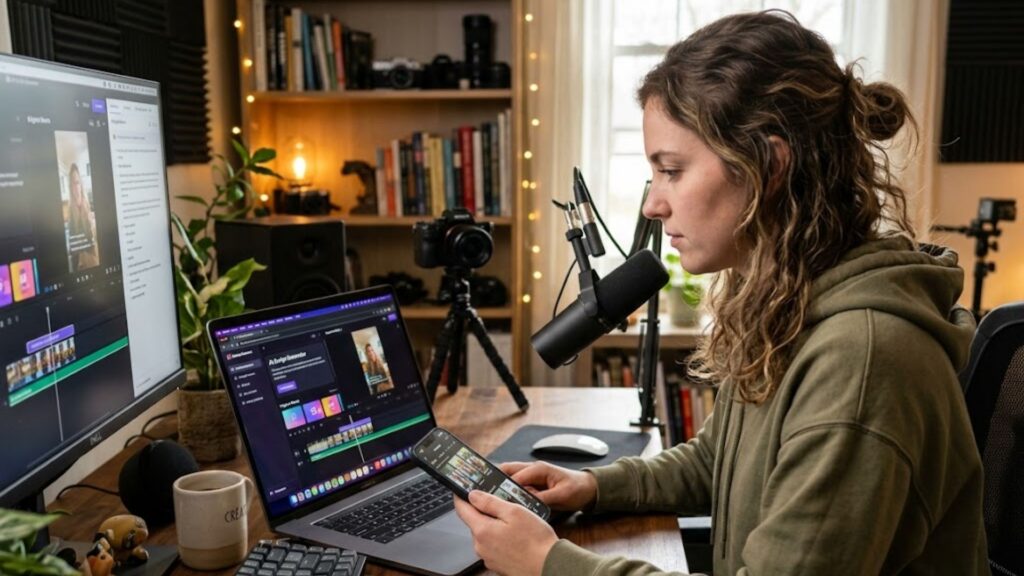
An AI script generator for shorts is most useful for volume at the hook stage, not for producing finished scripts you publish untouched. The workflow that actually works: generate 5 to 10 hook variations for one idea, pick the two strongest, then build the script around the winner. Writing the hook first forces a clear promise, which keeps everything after it focused.
Prompting matters more than the tool. Give it the formula, the audience, the constraint, and the format. “Generate 10 hooks for a Short about [topic] using curiosity gap, bold claim, and cost-of-inaction structures, each under 15 words” produces something usable. “Write me a video script” does not.
Then edit for voice. The generated draft is a skeleton, and your job is to add the specific number, the real example, and the one line only someone in your niche would write. Platforms built for this, including Syllaby AI, generate the script and the finished video in the same pass, which removes the gap where most creators lose momentum between writing and publishing. Teams running high output volume often check the credit and plan structure against their actual publishing cadence before committing, since script generation and video rendering are usually priced separately.
Larger operations sometimes skip the interface entirely and wire generation into their own pipeline through a programmatic video endpoint, which suits agencies producing hundreds of variations across client accounts. The script logic stays identical, only the delivery method changes.
Script Mistakes That Quietly Kill Retention
Most retention problems trace back to a small set of habits. Scan your last five scripts for these:
- Filler transitions. Cut “so basically,” “as you can see,” “now moving on,” “before we continue,” and “in this video.” They announce that nothing interesting is happening.
- The buried lede. If your most interesting point sits 15 to 20 seconds in, most of your audience never reaches it. Start with the payoff, then explain how you got there.
- The slow build. Context before hook works in a documentary and nowhere else in short form.
- Facts without emotion. A script that is only information reads like a textbook. Even educational faceless content needs curiosity, tension, or surprise.
- No visual cue. If the script does not say what is on screen, the edit will default to generic footage that undercuts the words.
- Length as a proxy for value. Longer is not better. Tighter is better.
Once you have removed those, the remaining gains come from testing rather than rewriting. Build a swipe file: a running document of hooks that made you stop scrolling, tagged by formula and by the retention they produced. Review it before every writing session.
How to Test Hooks Properly
Testing hooks means changing one variable and reading one metric. Produce two versions of the same video with different openings, publish them on different days at similar times, and compare average view duration and the percentage who watched past three seconds. Anything else you change at the same time makes the result unreadable.
Log the results back into your swipe file. After 10 to 20 videos you will see which two or three formulas your specific audience responds to, and you can lean into those while slowly testing new ones. This is the entire growth loop for a faceless channel, and it is the reason Syllaby AI users tend to test hooks in batches rather than one at a time, since a faceless video workflow that lets you spin up variations quickly compounds faster than one that makes each test expensive.
If your channel is already publishing consistently and retention still sits flat, the bottleneck is usually structural rather than creative, and it helps to walk through your current workflow with a specialist before adding more output on top of a template that is not converting.
Frequently Asked Questions
How long should a faceless video script be?
A five to ten minute faceless video needs roughly 700 to 1,500 words of narration, based on a speaking pace of about 140 to 150 words per minute. A 30 to 60 second Short needs roughly 70 to 150 words. Engagement matters more than hitting a word count, so cut anything that does not serve the promise you made in the hook.
How many seconds should a faceless video hook be?
Three seconds for the initial attention grab, though the full hook arc can stretch to five or six seconds. For Shorts the first three seconds are decisive. For long-form you have a little more room, but the hook should still land inside the first 10 to 15 seconds.
Do hook formulas still work when there is no face on camera?
Yes, and they work especially well. The structure of the hook does not change, only the delivery. Instead of speaking to camera, you deliver it through a bold text overlay, a voiceover, and a striking opening frame, with the first visual supporting the spoken claim.
Can AI write a full faceless video script?
AI can produce a complete first draft and is genuinely strong at generating hook variations at volume. It is weaker at the specific number, the real example, and the niche-specific voice that make a script feel credible. The reliable approach is AI for the skeleton and volume, human editing for the details.
Should Shorts and long-form use the same script template?
No. Shorts need a very short hook, a single tight value loop of two to three points, and a brief close. Long-form needs a longer intro, multiple payoff segments, and a re-engagement moment every two to three minutes. Keep one saved template per format and clone it so you can batch scripts and stay consistent.
Final Thoughts
A reliable faceless video script structure is the difference between publishing consistently and growing consistently. Lock the five blocks in order, respect the word budgets, write the hook before anything else, and treat the first three seconds as the most valuable real estate you own. Then test one variable at a time and let your retention graph tell you which formulas your audience actually rewards.
The creators who win at this are not more talented writers. They are running a system: a template, a hook library, and a testing loop. Build those three things once and every video after it gets easier to write and more likely to land.