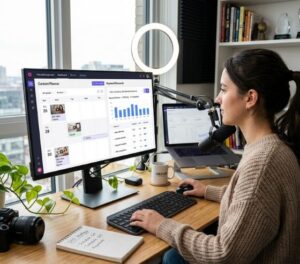






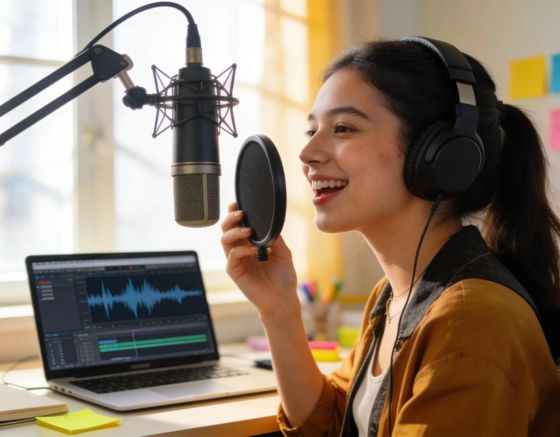
Voice cloning has changed how creators produce audio for video by enabling accurate synthetic reproductions of real voices. AI voice cloning lets users reproduce their own voice for narration and character work, improving viewer engagement and preserving a consistent brand tone. This guide explains the core concepts of AI voice tools, focusing on practical steps to clone a voice for video, how Syllaby’s voice cloning integrates into workflows, and the legal and ethical issues creators should address.
Key Takeaways
- AI voice cloning replicates human voices using machine learning to enhance video content personalization and production quality.
- Using AI voice cloning improves engagement by creating personalized synthetic voices that connect better with viewers.
- AI voice cloning significantly increases efficiency by reducing time and effort required for traditional voiceover recording.
- Syllaby’s voice cloning tool enables easy creation and integration of synthetic voices into video projects through a simple step-by-step process.
- Choosing the right AI voice cloning software involves evaluating voice quality, customization options, and pricing models.
- Legal and ethical considerations require obtaining consent, disclosing synthetic voice usage, and regularly auditing AI bias.
- Personalized synthetic voices on social media enhance engagement by aligning voice style with audience preferences and monitoring feedback.
- Scalable AI voice generation offers cost savings, faster production, and flexible subscription plans for content creators.
- Ethical use of synthetic voices involves consent-first policies, transparent disclosure, and human review to maintain trust.
What Is AI Voice Cloning and How Does It Enhance Video Content?
AI voice cloning uses machine learning to analyse a speaker’s vocal patterns and produce a digital voice model that can generate speech matching the original. For video creators, the main advantage is consistent, on-demand narration that reduces scheduling and recording overhead. Automating voiceovers speeds production while allowing more personalized audio that supports stronger viewer engagement.
AI Voice Cloning: Transformative Innovation or Emerging Risk?
AI voice cloning, alternatively known as voice synthesis, employs machine learning algorithms to replicate human speech. This technology necessitates a specific volume of vocal data to analyze and integrate the distinctive acoustic features of an individual. Once trained, the system can generate speech that closely emulates the original voice. This systematic literature review provides empirical insights into whether AI voice cloning technology represents a transformative innovation or a potential threat. A systematic literature review on AI voice cloning generator: A game-changer or a threat?, GG Genelza, 2024
What Are the Benefits of Using AI Voice Cloning for Video Creators?
AI voice cloning delivers practical benefits that help creators scale production without sacrificing quality.
- Improves Engagement: Personalized synthetic voices can create a stronger connection with viewers, enhancing their experience.
- Increases Efficiency: Voice cloning drastically reduces the time needed to produce voiceovers, allowing creators to focus on other aspects of video production.
- Allows for Personalization: Creators can produce diverse content styles and tones by adjusting their cloned voice to fit different narratives or themes.
Collectively, these advantages streamline workflows and support a higher output of consistent, audience-focused content.
Step-by-Step Process: How to Create AI Voiceovers with Syllaby’s Voice Cloning Tool
Generating AI voiceovers with Syllaby follows a clear sequence of steps designed for efficiency and quality control.
- Create an Account: Sign up on the Syllaby platform to access its suite of voice cloning tools.
- Voice Recording and Uploading: Record your voice samples and upload them to the platform.
- Generating and Using Cloned Voices: Utilize the voice cloning tool to generate synthetic voices based on your recordings. You can then integrate these voices into your video projects.
How to Integrate Cloned Voice into Your Video Projects
Successful integration requires compatible editing software and attention to timing, tone, and pacing so the synthetic voice matches visual cues and narrative flow.
- Setup Requirements: Ensure that you have the necessary video editing software that supports audio layering.
- Best Practices for Using Cloned Voices: Maintain consistent tone and pacing to match the visuals, enhancing the storytelling aspect.
- Software Recommendations: Consider using popular video editing tools like Adobe Premiere Pro or Final Cut Pro to facilitate seamless integration.
Which AI Voice Cloning Software Offers the Best Features for Video Production?
Several vendors provide voice cloning tools; reviewing feature sets and integration options clarifies which product fits a given workflow. For a closer look at available capabilities, see AI voice cloning features.
| Product | Features | Pricing |
|---|---|---|
| Syllaby | Automated video content creation, customizable voice options | Competitive pricing offered per subscription level; varying price tiers tailored for specific needs |
| Competitor A | Basic cloning features, limited voice options | Lower pricing but fewer functionalities |
| Competitor B | Advanced voice tuning, multilingual capabilities | Premium pricing for extensive features |
These comparisons highlight differences in functionality, helping creators match tool capabilities to project needs and budgets.
How to Choose the Right AI Voiceover Tool for YouTube and Social Media Videos
Choose a tool based on voice realism, control over tone and pitch, and cost structure to ensure the solution aligns with platform demands and production frequency.
- Evaluate Voice Quality: Higher quality synthetic voices result in a more engaging viewer experience.
- Consider Customization Options: Tools that allow for pitch modulation and tone adjustments are essential for creating personalized content.
- Assess Pricing Models: Choose a tool that fits your budget while offering the necessary features for your projects. For information on pricing, consider Syllaby’s pricing plans.
Applying these criteria helps creators select a tool that balances sound quality, flexibility, and cost-effectiveness.
What Are the Legal and Ethical Considerations When Using AI Voice Cloning for Videos?
AI voice cloning raises legal and ethical issues that must be managed through clear consent, transparent disclosure, and regular bias assessments of the underlying models.
- Consent Requirements: Always ensure that you have the explicit consent of individuals whose voices you might replicate.
- Disclosure of Synthetic Elements: Transparently inform your audience when synthetic voices are used to maintain trust.
- Bias Audits: Regularly assess the AI systems for bias and ensure fairness in voice representation.
Best Practices to Ethically Use Synthetic Voices in Video Narration
Adopt consent-first policies, disclose synthetic use to audiences, and include human review checkpoints to ensure outputs meet ethical and quality standards.
- Consent-First Policies: Always obtain prior consent from individuals before cloning their voices.
- Disclosure Practices: Clearly indicate when content features synthetic voices.
- Human Review for Ethical Standards: Regularly review automated scripts and voice outputs for appropriateness and alignment with ethical norms.
Deep Learning Applications in Voice Cloning Technology This paper provides a comprehensive review of the rapidly evolving field of voice cloning, emphasizing the paradigm shift from conventional speech synthesis methods to modern deep learning-based approaches. Through a rigorous analysis of diverse methodologies, their intrinsic advantages and disadvantages, and their practical applications, this review offers a holistic perspective on the current state of voice cloning technologies. Additionally, it explores the ethical considerations and anticipated future developments in voice cloning, thereby outlining critical directions for subsequent research in this domain. Implementation of novel voice cloning method based on comprehensive review of voice cloning technologies: Methodology, applications, and future directions, 2025
How to Maximize Engagement With Personalized Synthetic Voices on Social Media Videos?
Match the cloned voice to your audience and content style, use narrative techniques that emphasise relatability, and measure responses to refine voice settings over time.
- Utilizing Personalized Voices Effectively: Tailor your synthetic voice to align with the content style that resonates with your specific audience.
- Creating Engaging Content: Use stories and relatable scenarios that leverage the emotional connection of the cloned voice.
- Monitoring Audience Response: Keep track of viewer feedback to continuously refine voice personalization for improved engagement.
Examples of Successful Lead Generation Using AI Voice Cloning
Some brands have used personalized synthetic voices in campaigns and reported higher conversion rates and improved lead generation. For case studies on commercial applications, see Syllaby’s industry applications.
AI Voice Cloning for Enhanced Distance Learning Engagement
This study presents the design and empirical evaluation of an AI-powered virtual office hours platform. This platform leverages voice cloning technology to simulate the real-time presence of instructors within distance education environments. The system was implemented in an undergraduate course on Innovation, Entrepreneurship, and Sustainability. User-submitted questions received spoken responses generated through text-to-speech synthesis utilizing the cloned instructor’s voice. This functionality was achieved by integrating large language models (LLMs), voice synthesis (ElevenLabs), and Retrieval-Augmented Generation (RAG). Enhancing Distance Learning through AI-Powered Voice-Based Virtual Office Hours: A Case Study in an Innovation, Entrepreneurship, and Sustainability Course, EK Alquqa, 2025
What Are the Pricing Plans and Subscription Benefits for Syllaby’s AI Voice Cloning Software?
Syllaby provides tiered subscription plans aimed at different production needs; reviewing plan limits helps creators budget and choose the right level of access. See full details on their pricing page.
- Basic Plan: Includes one voice, 20 scheduled posts, and 5GB storage.
- Standard Plan: Offers three voices, 60 scheduled posts, and 10GB storage.
These plan options enable creators to pick a subscription that balances feature needs with cost control.
What Are the Cost Benefits of Scalable AI Voice Generation for Content Creators?
Scalable AI voice generation can reduce reliance on external talent, shorten production timelines, and provide subscription pricing that fits recurring workflows.
- Cost Savings: By decreasing the need for professional voice actors, creators can cut down on production costs.
- Increased Production Speed: Rapid voice generation allows for quicker turnaround times on video projects.
- Flexible Pricing Plans: Subscription models provide budget-friendly flexibility for creators of all sizes.
These economic benefits support higher output and lower per-project costs. For specific questions, contact support via the Syllaby contact page.
Frequently Asked Questions
What types of content can benefit from AI voice cloning?
AI voice cloning suits educational videos, marketing content, podcasts, and social media posts where consistent narration or customised tones improve comprehension and retention. In education, it can personalise instructions; in marketing, it can deliver a unified brand voice across channels.
Are there limitations to using AI voice cloning?
Limitations include dependence on the quality and quantity of source recordings and occasional shortfalls in reproducing subtle emotional nuance. Legal and ethical constraints, such as consent and disclosure, also limit certain uses and require careful management.
How can I ensure the ethical use of AI voice cloning?
Follow a consent-first approach, disclose synthetic voice usage to your audience, and run periodic bias and quality audits on the tools you use. These measures protect users and preserve audience trust.
What are some practical applications of AI voice cloning in business?
Businesses use voice cloning for customer service personas, virtual assistants, training simulations, and consistent brand messaging across multimedia. These applications improve scalability while maintaining a coherent audio identity.
How does AI voice cloning impact accessibility in video content?
Cloned voices can expand accessibility by providing alternative audio narration, supporting language variants, and offering clear, consistent delivery for diverse audiences, which improves reach and inclusivity.
Can AI voice cloning be used for live presentations?
AI voice cloning can support live events in controlled ways, such as pre-recorded segments or assisted responses, but real-time adaptability is limited; a hybrid approach that combines human delivery with synthetic elements often works best.
What trends are emerging in AI voice cloning technology?
Trends include better deep learning models for naturalness, more granular voice control, multilingual support, and stronger industry emphasis on transparency and bias mitigation.
Conclusion
AI voice cloning delivers measurable gains in efficiency, personalization, and production consistency for video creators. When applied with clear consent and disclosure practices, synthetic voices can elevate content without compromising trust. To explore how Syllaby’s tools can support your content strategy, review our offerings and consider which plan aligns with your production goals.