







An AI video API converts simple text prompts into fully rendered MP4 video files by orchestrating natural language processing, visual diffusion models, neural speech engines, and cloud rendering pipelines. When a client application submits a request payload using a valid Syllaby AI API key, the platform authenticates the user, parses the textual script into timed scene instructions, synthesizes matched visual and audio frames, and encodes the compiled media for distribution. This programmatic automation enables software applications to generate studio-quality video clips on demand without manual editing software or dedicated hardware.
Modern content production relied for decades on manual filming, specialized camera operators, and labor-intensive timeline editing. Today’s cloud infrastructure replaces these traditional bottlenecks by exposing generative video algorithms directly to developers through programmatic interfaces. Evaluating the underlying mechanisms of this technology illustrates how simple script instructions transform into high-definition digital media.
Foundations of Programmatic Media Generation

An Application Programming Interface acts as a secure computational connector between external applications and cloud infrastructure. In programmatic media workflows, APIs allow developers to initiate complex rendering operations directly from web apps, mobile backends, or automated server scripts. Rather than relying on human graphical user interfaces, software sends structured data packets across standard web protocols.
Developers seeking to integrate programmatic media generation often start by understanding AI video API fundamentals to grasp how backend neural networks process media requests. Traditional rendering engines recalculate 3D lighting and polygon meshes, whereas artificial intelligence models construct pixels through deep probabilistic calculations learned during model training.
The core benefit of programmatic media creation lies in scalability and speed. Applications can automatically convert text articles into news broadcasts, construct personalized video clips for e-commerce shoppers, or localized promotional videos across regional markets within minutes. Every step occurs automatically in the cloud through structured data exchanges.
Technical Architecture of Automated Video Infrastructure
Cloud video architectures operate as distributed systems built to manage memory-heavy calculations. When a client application sends a creation request, the system routes the incoming data packet through multiple backend services designed for distinct computational tasks.
The core architecture consists of six primary subsystems working in concert:
- API Gateway and Rate Limiter: Validates client requests, checks access tokens, and prevents system abuse.
- Message Broker and Queue: Holds incoming requests in ordered queues until compute capacity opens up.
- Script Analysis Engine: Large language models refine prompts, establish camera directions, and calculate temporal beat timing.
- Generative Visual Clusters: High-performance GPU servers running diffusion algorithms construct individual frames and handle motion vectors.
- Audio and Speech Models: Neural speech generators render natural voiceovers and map mouth shapes for lip synchronization.
- Assembly and Encoding Engine: Media processing utilities unify disparate frame rates and normalize resolutions before combining video frames, audio tracks, and graphic overlays into standard file formats.
Separating these operations into modular microservices guarantees system stability. If demand spikes for visual frame creation, additional GPU instances scale up automatically without interrupting the API gateway or audio processing nodes.
Authentication and Request Processing with a Syllaby AI API Key

Initiating a video creation request using a Syllaby AI API key allows developers to bypass manual video editing workflows and automate media production programmatically. The security layer validates credentials, inspects account quotas, and verifies request formatting before any rendering computation begins. The API key must be transmitted within the HTTP authorization header as a Bearer token to protect client identification credentials.
{
“prompt”: “A modern tech workspace with glowing monitors and subtle camera movement”,
“aspect_ratio”: “16:9”,
“voice_id”: “en_us_professional_male”,
“duration_seconds”: 15
}
The system checks incoming parameters to ensure requested frame rates, aspect ratios, and durations fall within supported operational limits. Request validation rules immediately flag invalid entries, such as unsupported resolutions or missing required fields, returning descriptive error codes back to the client application.
Once a request passes validation checks, the gateway assigns a unique tracking identification string to the task. The job details enter a distributed message queue, and the server returns an immediate HTTP response acknowledging receipt of the job.
Parsing Prompts and Structuring Visual Scripts
After authentication, the request enters the natural language processing stage. Raw user prompts often lack the granular technical instructions necessary to create visually engaging, cohesive video scenes across extended durations.
During this stage, natural language models expand simple user inputs into comprehensive visual blueprints. The system identifies subject details, setting characteristics, lighting conditions, and camera parameters such as focal length or movement speed. Developers utilizing the Syllaby AI platform benefit from automated prompt expansion that optimizes script formatting for maximum visual fidelity.
The expanded text is subsequently divided into distinct chronological scenes or beat sequences outputted as structured JSON beat markers containing timestamps, visual prompts, and camera motion vectors. The script analyzer estimates exact timing durations for each segment and determines transition types between visual changes. This temporal blueprint serves as the structural foundation for both visual and audio generation modules.
Visual Frame Generation and Temporal Motion Synthesis
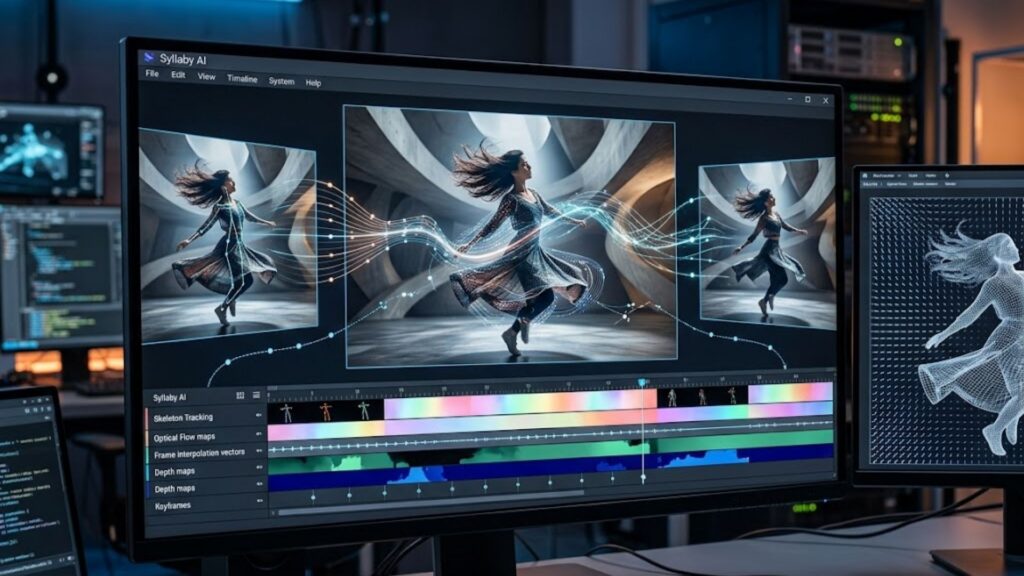
Converting textual scene descriptions into motion graphics relies on deep generative vision models. The platform leverages spatio-temporal diffusion algorithms and variational autoencoders (VAEs) to decode latent noise representations into high-definition image frames in pixel space.
Generative video endpoints generally execute visual frame creation through one of two primary computational approaches:
- Keyframe Generation and Interpolation: The model renders high-resolution keyframes for major scene beats, then applies motion estimation models to calculate smooth intermediate frames.
- Direct Latent Space Video Diffusion: The system samples noise across a three-dimensional tensor representing height, width, and time, denoising all video frames simultaneously.
Maintaining visual consistency across consecutive frames represents a primary engineering objective during motion synthesis. Without temporal control layers, characters, lighting, or background elements may shift unnaturally between adjacent frames.
To maintain visual stability, temporal attention mechanisms compare feature maps across adjacent frames. Techniques such as self-anchoring allow the system to reference prior frame states, keeping character appearances, clothing patterns, and environmental textures consistent throughout the clip.
Audio Generation, Synthetic Speech, and Lip-Sync Alignment
While visual frames process on specialized GPU clusters, the system simultaneously processes necessary audio components. Complete video outputs combine neural speech generation, background audio layers, and precise lip synchronization.
Neural Text-to-Speech models convert script dialogue into clear human speech waveforms. These algorithms manage cadence, emphasis, pitch adjustments, and natural pauses to match the requested character voice profile.
When the target output features a visible digital actor or avatar, facial tracking models execute phoneme-to-viseme mapping. This pipeline matches spoken sound units to specific physical mouth configurations, transforming vocal sound timing into precise facial mesh deformations.
The system deforms the facial mesh or modifies mouth pixels frame by frame, synchronizing lip movements directly with the generated speech track.
Video Compositing, Asset Assembly, and File Encoding
Once visual frames, voiceovers, and secondary audio layers complete processing, the assembly engine combines these separate elements into a single cohesive media container. Distributed rendering clusters leverage automated compositing software to execute assembly tasks.
During asset assembly, the engine overlays background audio tracks beneath the primary voiceover, applying automated ducking to lower background music volume whenever speech occurs. Visual transitions, lower-third graphics, text overlays, and automatically generated closed captions burn into frame buffers based on calculated script timestamps.
The completed sequence passes to GPU-accelerated video encoding libraries. The engine compresses raw pixel arrays into widely compatible codecs, primarily H.264 video with AAC audio inside an MP4 container.
This compression process optimizes file size while maintaining high visual clarity, preparing the final output file for smooth streaming across mobile devices and web applications.
Asynchronous Workflow Management, Webhooks, and Delivery

Creating generative video content demands significant computational resources, requiring execution times ranging from 15 seconds to several minutes depending on duration and complexity. Because standard web requests time out if kept open too long, video APIs rely on asynchronous architectures.
Instead of keeping the connection open until rendering finishes, the initial server response returns immediately with a unique job ID. Client applications monitor job execution through two primary delivery strategies:
- Polling Approach: The client application periodically queries a status endpoint using the assigned job ID to check whether generation is queued, processing, completed, or failed.
- Webhook Listener Approach: The client application includes a secure destination URL inside the initial payload. Once processing finishes, the server posts a completion notification directly to the client endpoint.
When a video completes rendering, the storage service uploads the final file to a Content Delivery Network storage bucket. Developers reviewing developer API documentation can find explicit code patterns for setting up secure webhook endpoints and parsing completion payloads.
Performance Breakdown Across Processing Stages
To illustrate how data transforms across the execution lifecycle, the following table details inputs, outputs, system tasks, and processing times at each stage of the pipeline.
| Workflow Phase | Primary Technical Task | Input Payload Data | Generated Output Data | Expected Processing Latency |
| Request & Auth | Credential checks, rate checks, job creation | JSON request payload | Unique Job ID | Under 200 milliseconds |
| Script Analysis | Prompt parsing, scene breaking, beat timing | Text script prompt | Structured scene breakdown | 1 to 3 Seconds |
| Visual Diffusion | Denoising diffusion, frame interpolation | Scene descriptors | Uncompressed frame buffers | 15 to 90 Seconds |
| Audio Synthesis | Speech generation, viseme extraction, lip-sync | Script dialogue text | WAV audio & mouth coordinate maps | 2 to 5 Seconds |
| Asset Compositing | Audio ducking, subtitle overlays, encoding | Frame buffers & audio tracks | Encoded MP4 file | 5 to 15 Seconds |
| CDN Distribution | Cloud storage transfer, webhook dispatch | Finished MP4 asset | Secure public video URL | Under 1 Second |
Industry Applications and Production Use Cases
Automating video creation using programmatic infrastructure unlocks efficiency gains across many commercial sectors. Replacing manual camera setups and timeline editing with code requests allows organizations to build custom media workflows tailored to their operational goals.
Organizations deploy automated video generation across several core applications:
- E-Commerce Platforms: Automatically generating dynamic product highlight videos from catalog product descriptions for targeted ad campaigns.
- Corporate Education: Converting updated text documentation and compliance materials into engaging video training modules instantly.
- Digital News Publishing: Converting written news updates into short vertical video clips optimized for social media feeds.
Companies operating in specialized fields can explore industry-specific video creation to streamline content publishing while preserving consistent brand aesthetics across thousands of generated outputs.
When scaling production pipelines, enterprise teams analyze operational needs alongside scalable pricing plans to select compute capacity that aligns with anticipated volume requirements.
Integration Best Practices and System Reliability
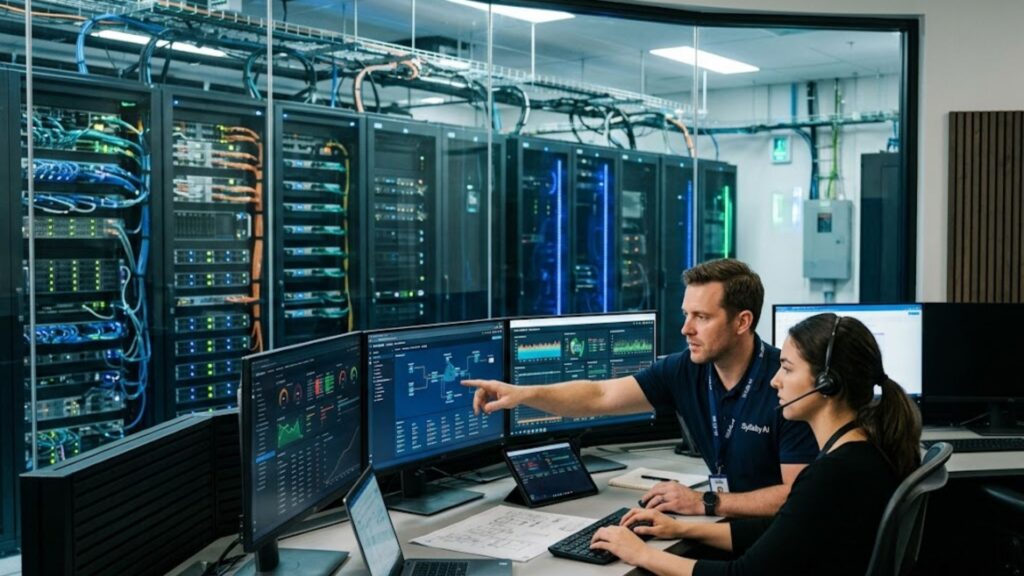
Building resilient automated video production applications requires strategic system planning to handle network disruptions, unexpected traffic spikes, and input variations smoothly. Production systems should incorporate robust error handling, rate limit management, and fallback routines.
Key practices for integrating media generation endpoints include:
- Implement Exponential Backoff Retries: Network timeouts or server responses with status codes like 429 (Rate Limit Exceeded) or 503 (Service Unavailable) should trigger delayed retry requests rather than causing job failures in client applications.
- Pre-Validate Input Scripts Client-Side: Confirm that text prompts satisfy character limits and parameter requirements before calling the server to prevent avoidable validation errors.
- Prefer Webhooks Over Frequent Polling: Minimize server overhead and network traffic by configuring secure webhook receivers instead of making high-frequency status calls.
- Cache Static Visual Assets: Store reusable media assets on local edge nodes to accelerate compositing operations.
Engineering teams planning large-scale deployments can reach out to the team to request specialized technical guidance, explore dedicated cluster options, or review enterprise support arrangements.
Frequently Asked Questions
How long does an AI video API take to render a video from text?
Total rendering time varies based on output duration, frame rate, resolution, and current cluster load. Simple short clips processed through optimized diffusion models generally complete within 15 to 30 seconds. Higher-resolution clips or multi-minute projects featuring complex avatar lip-syncing may require 2 to 5 minutes to complete assembly and encoding.
What is the difference between synchronous and asynchronous video API processing?
A synchronous API call holds the network connection open until rendering finishes, which frequently results in client timeouts during complex media tasks. An asynchronous API call accepts the request payload instantly, returns a tracking job ID, and performs video rendering in background queues. The server notifies the client via webhooks or status checks when the final file is ready.
How do visual models maintain character consistency across different frames?
Visual models maintain continuity by applying temporal attention layers, fixed random seeds, and continuous frame conditioning. Advanced generation pipelines utilize temporal self-anchoring, where newly generated frames directly reference preceding frame features, ensuring that facial details, clothing, and background textures stay consistent across the timeline.
Can automated video APIs create voiceovers and captions automatically?
Yes, modern media endpoints integrate natural language processing and neural speech engines into the main rendering pipeline. The system converts text dialogue into natural human voiceovers, extracts timecodes for spoken words, and automatically burns synchronized captions onto video frames during final compositing.
What media formats and resolutions do video creation endpoints support?
Most video generation platforms export completed media files as standard MP4 containers encoded with the H.264 video codec and AAC audio codec. Systems typically support standard aspect ratios across resolutions ranging from 720p HD up to 1080p Full HD or 4K Ultra HD.
Conclusion
The transformation of plain text into a fully rendered digital video represents an impressive synthesis of distributed cloud infrastructure, natural language models, neural speech engines, and deep visual diffusion. By breaking complex video creation tasks into modular parsing, visual diffusion, audio alignment, and GPU-accelerated encoding steps, modern cloud endpoints turn sophisticated media production into simple programmatic requests.
Starting your integration begins with acquiring a Syllaby AI API key, defining target media configurations, and building asynchronous webhook listeners within your client application. As underlying artificial intelligence models advance in speed and visual rendering quality, programmatic video workflows will remain the cornerstone of automated media production.