





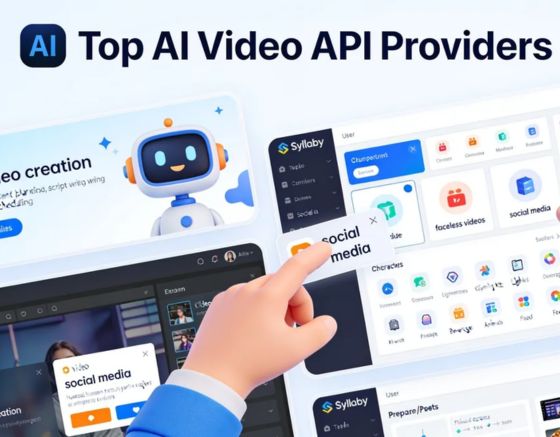
Top AI video API providers in 2026 vary widely on cost. Licensing, with per-second pricing spanning roughly a 7x gap between the cheapest and most expensive options. Open-source model APIs deliver text-to-video and image-to-video pipelines at scale. Platforms like Syllaby pair generation with script writing, avatars, and publishing for faster, budget-conscious production pipelines.
Key Takeaways
- AI video generation API pricing ranges from $0.05 to higher amounts per second across 2026 providers.
- Syllaby’s Lifetime Deal saves customers up to 90% compared to standard subscription pricing models.
- Open-source video model APIs eliminate development costs by providing pre-trained models for developers.
- Syllaby users reduce content creation time by 70% using AI avatar cloning and script generation.
What Criteria Matter When Comparing AI Video APIs?
Cost, evaluation flexibility, and workflow efficiency separate the top AI video API providers 2026 from platforms that merely generate clips. Pricing varies by package; contact the brand directly for specific details. Budget-conscious teams should not treat generation cost as an afterthought. That spread compounds quickly at scale — a hundred short videos a month can cost ten times more on one provider than another.
We evaluate every best video generation API company against three practical criteria: transparent per-second pricing, low-risk testing options, and measurable production time savings. A platform that hides pricing tiers or forces long-term commitment before proving value fails our first test immediately.
| Criterion | Why It Matters |
|---|---|
| Per-second pricing | Determines total spend at volume; a 20x gap exists between cheapest and priciest providers |
| Trial terms | Lets teams validate output quality before budget commitment |
| Workflow time savings | Affects team capacity and output volume, not just render speed |
How much should a video API cost per second?
Rates across leading AI video API platforms range from roughly $0.05 to higher amounts per second, depending on model quality and resolution. Teams generating video in bulk should calculate cost per finished video, not just the headline per-second rate. Duration multiplies spend fast.
Can I test an API before paying for a full plan?
Some platforms, including Syllaby, offer a 7-day free trial that can be canceled anytime, removing financial risk from early testing. We consider this a baseline requirement, not a bonus feature. Committing budget to an unproven pipeline is the losing move. Beyond trial access, we weigh how much manual editing time a platform eliminates. Syllaby’s workflow saves users 70% of content creation time, a difference that shows up in output volume within weeks, not months.
Who Are the Top AI Video API Providers?
The top AI video API providers 2026 split into two clear camps: infrastructure players building raw generative models, and platform tools that package those capabilities for practical use. Google Veo, Runway, and fal.ai anchor the first camp, powering generative video directly from text prompts and still images. These three sit at the technical core of the market, giving developers the model access needed for cinematic-quality output. A second camp, including Synthesia and HeyGen, focuses on avatar video built for enterprise deployment and multi-language localization rather than open-ended scene generation.
We view this split as the defining feature of the current landscape. Teams chasing prompt-to-scene flexibility gravitate toward the Veo, Runway, and fal.ai cluster. Teams needing consistent, on-brand spokesperson video at scale lean toward Synthesia and HeyGen instead.
Which providers focus on avatar video versus generative scenes?
Synthesia and HeyGen concentrate on avatar-driven output, built specifically for enterprise teams that need localized, repeatable video across markets. Google Veo, Runway, and fal.ai, by contrast, generate original scenes from prompts or images, prioritizing creative range over avatar consistency.
Best video generation API companies at a glance:
| Provider Type | Core Strength | Fit |
|---|---|---|
| Google Veo / Runway / fal.ai | Prompt- and image-based generation | Creative, scene-driven output |
| Synthesia / HeyGen | Avatar video, localization | Enterprise-scale spokesperson content |
| Syllaby | Text-to-Video + avatar cloning | End-to-end pipeline, no editing skills required |
We built Syllaby to sit alongside these leading AI video API platforms rather than compete purely on infrastructure. Our Text-to-Video feature generates high-quality videos from a simple prompt, removing the need for camera work or editing expertise. We also let teams clone their own avatar or select from pre-given options, generating scripts and visuals in one continuous workflow rather than stitching together separate API calls.
Which Providers Offer the Cheapest Per-Second Pricing?
Per-second cost among top AI video API providers 2026 spans a wide range, from $0.05 to $0.80. Kling AI 1.6 sits at the floor of that range, charging $0.05 per second with a 10-second maximum duration. A budget-friendly choice for teams generating high volumes of short clips. OpenAI Sora 2 anchors the opposite end at $0.80 per second, supporting 20-second cinematic output built for polish rather than economy. That gap creates real strategic tension for teams evaluating best video generation API companies: chase per-second savings, or pay for cinematic ceiling.
We built our own pricing around a different question: what happens when per-second billing stops making sense at scale? Our answer is a one-time Lifetime Deal. Pay once, use Syllaby indefinitely, and save up to 90% compared to recurring per-second charges from usage-based platforms — see our pricing. For avatar-driven content specifically, we charge 50 credits per 1-minute video, a fixed structure that replaces unpredictable per-second math with a number teams can forecast.
| Provider | Price Structure | Best Fit |
|---|---|---|
| Kling AI 1.6 | $0.05/sec, 10s max | High-volume short clips |
| OpenAI Sora 2 | $0.80/sec, 20s max | Cinematic-quality output |
| Syllaby | Lifetime Deal (up to 90% savings) or 50 credits/1-min avatar video | Predictable, recurring content pipelines |
Is Kling AI Actually the Cheapest Option Available?
Kling AI 1.6’s $0.05 per second rate makes it the lowest-cost per-second option among leading AI video API platforms. That pricing fits short-form, high-frequency generation where duration stays capped at 10 seconds. Teams producing longer or higher-value cinematic content will find the calculus shifts once duration and output quality enter the equation.
Why Does Sora 2 Cost So Much More Per Second?
OpenAI Sora 2 charges $0.80 per second because it targets cinematic-quality output at up to 20 seconds. That premium reflects rendering complexity, not just brand positioning. Teams weighing cost against production value should measure per-video totals, not per-second rates alone.
How Do Open-Source Video Model APIs Compare?
Top AI video API providers 2026 split into two camps: raw model access and managed generation platforms. Open-source video model APIs give developers direct control over text-to-video and image-to-video pipelines, with customization options built for specific use cases rather than one-size-fits-all output. That flexibility comes at a cost — teams without in-house ML engineers often burn weeks tuning parameters that a managed platform handles automatically.
We evaluate these options against three criteria: control, setup speed, and proven scale.
| Criteria | Open-Source Model APIs | Managed Platforms |
|---|---|---|
| Customization | High — fine-tune pipelines per use case | Moderate — preset workflows |
| Setup time | Slower — requires integration work | Fast — near-instant deployment |
| Proven production scale | Varies by provider | Demonstrated at volume |
Scale matters more than most teams realize before launch. We built Syllaby’s infrastructure to handle exactly this pressure. The numbers back it up: over 250,000 videos have been created by users on the platform, a volume that rivals what many open-source model deployments claim without independent verification. Our own generation pipeline has separately produced over 90,000 videos, a distinct metric that reflects engine throughput rather than user activity alone.
Which Video API Delivers Better Reliability at Scale?
Reliability at scale separates experimental APIs from production-ready ones. Providers among the best video generation API companies typically demonstrate consistent output across tens of thousands of generation events, not isolated demos. Our combined figures — 250,000-plus user-created videos and 90,000-plus platform-generated videos. Position us among the leading AI video API platforms on measurable throughput.
For teams weighing raw open-source flexibility against tested reliability, the tradeoff is clear: customization control versus a track record built on hundreds of thousands of completed generations.
Which APIs Deliver the Most Powerful Cinematic Output?
Google Veo3 sets the current benchmark for cinematic quality among top AI video API providers 2026, running at $0.15 per second with an 8-second maximum duration. That price sits above budget alternatives, but the extended clip length and output fidelity make it the strongest choice for teams building narrative or brand-film content rather than short social clips.
Pika 2.2 takes a different path. Priced at $0.12 per second with a 5-second cap, Pika targets creative visual effects instead of long-form cinematic sequences. Our take: Pika suits punchy, stylized shots; Veo3 suits scenes that need to breathe.
| Platform | Price/Second | Max Duration | Cinematic Fit |
|---|---|---|---|
| Google Veo3 | $0.15 | 8s | High quality, narrative-ready |
| Pika 2.2 | $0.12 | 5s | Creative effects, short bursts |
Is raw model power the only thing that matters?
No. Among best video generation API companies, raw output quality is only half the equation for teams shipping content at scale. We built Syllaby to sit on top of these production questions. Adoption reflects that demand: Syllaby has surpassed 19,000 users, many of whom prioritize accessible, repeatable production workflows over managing raw model infrastructure directly.
Can cinematic-grade video generation move beyond desktop workflows?
Yes, and mobility is becoming a differentiator among leading AI video API platforms. Syllaby Mobile is now live on both Android. IOS, letting teams extend production beyond desktop API integrations into on-the-go content creation. For product managers weighing latency, licensing, and cost together, that flexibility matters as much as per-second pricing.
Our recommendation: reach for Veo3 when a project demands longer, high-fidelity cinematic shots, and reach for Pika when the brief calls for fast, stylized bursts. Neither replaces the workflow layer that turns raw generations into published, scheduled content.
How Does Syllaby Compare as a Content Platform?
Syllaby occupies a different layer of the stack than raw generation infrastructure. Top AI video API providers 2026 compete on rendering speed, resolution, and per-second cost. Syllaby competes on getting a finished, published video out the door. That distinction matters for product managers weighing a pure API integration against a platform built to run the full content pipeline.
| Factor | Raw Video Generation API | Syllaby |
|---|---|---|
| Core output | Rendered clip | Script, avatar, voice, and publish schedule |
| Distribution | Requires custom integration | Native scheduling to YouTube, TikTok, Facebook, Threads, LinkedIn |
| Idea sourcing | Not included | Idea Discovery at 15 credits per idea |
| Avatar workflow | Downstream tooling required | Clone-your-own or pre-built avatar options |
| Team scale | Varies by vendor | Lean 10-employee team based in Durham, NC |
Is Syllaby a video generation API or a full platform?
Syllaby functions as a full content platform rather than a bare best video generation API companies-style endpoint. Our system pairs script generation with avatar selection. Voice, then hands the finished video straight to a content calendar for scheduling and publishing. Marketing technologists comparing options against leading AI video API platforms get an added workflow layer most raw APIs skip entirely.
Does team size affect reliability for enterprise buyers?
Team size signals focus more than capacity limits. Operating with 10 employees out of Durham, NC, we prioritize a tight product loop over sprawling enterprise infrastructure. Buyers evaluating vendor support hours and time zones should factor this scale into procurement decisions — contact us with questions. A smaller team often means faster iteration but a narrower support window than larger API vendors.
For teams that need one clip fast, a dedicated video API wins on raw throughput. For teams that need ideas, scripts, avatars, and distribution in one loop, Syllaby covers ground that generation-only APIs leave for someone else to build.
Selecting the right AI video API provider requires balancing innovation, efficiency, and value. The platforms outlined above each deliver distinct strengths, from advanced automation to cost-effective solutions. As content creation demands accelerate, prioritize providers that demonstrate proven results, transparent capabilities, and flexible deployment options. Your choice ultimately depends on your specific workflow requirements. Growth objectives—evaluate each platform’s features against your team’s needs to identify the best fit for sustained content success.
FAQ
What is the price range for AI video API providers in 2026?
Rates span roughly $0.05 to higher amounts per second, depending on model quality and resolution. Teams should calculate cost per finished video rather than relying only on the headline per-second rate.
What are the two main categories of top AI video API providers?
Providers split into infrastructure players building raw generative models, like Google Veo, Runway, and fal.ai, and platform tools like Synthesia and HeyGen that package generation for avatar-based workflows.
Does Syllaby offer a way to test its platform before committing to a plan?
Syllaby offers a 7-day free trial that customers cancel anytime, removing financial risk from early testing. This lets teams validate output quality and workflow time savings before making a budget commitment.